MILES by Oliver Kaderbhai – ★★★★☆
Oliver Kaderbhai's MILES offers a skilfully crafted exploration of Miles Davis, weaving together past and present to examine both the man and his enduring musical legacy. The production centres on JP (Jay Phelps), a modern-day jazz artist and DJ signed to Columbia Records, who turns to the recorded tapes of the legendary trumpeter for inspiration as he seeks his own artistic voice.
The setup proves immediately immersive. In this 2-person dynamic, JP is haunted by Davis. Benjamin Akintuyosi's portrayal of Davis is captivating. It becomes extremely hard to take your eyes off him. He embodies the jazz icon so convincingly that you feel transported back to the 1950s, listening to Miles himself recount his life. The dynamic between ghost and inheritor is skilfully rendered, with Davis alternating between critical and supportive as JP tries to capture the essence of Davis's music to inform his own journey with jazz. However, the opening humour between the pair doesn't quite land, momentarily breaking the spell of their imagined relationship. Thankfully, this awkwardness dissipates as the production deepens.
The production makes masterful use of projections, displaying archival material of key Davis collaborators (Bill Evans, John Coltrane, Cannonball Adderley) alongside photographs spanning Davis's life. This visual layer adds a deeply personal dimension to the storytelling, grounding the abstract exploration of musical genius in concrete historical reality.
Ellie Wintour's set design features a grand piano centre stage flanked by doors and windows evoking 1940s European architecture. Alex Lewer's lighting design proves particularly effective in navigating the play's temporal shifts. Blue light situates us in Davis's past, soft white illuminates JP's present-day scenes and striking yellow light marks moments of pain, metamorphosis and transformation – most notably during the depiction of Davis's heroin struggles.
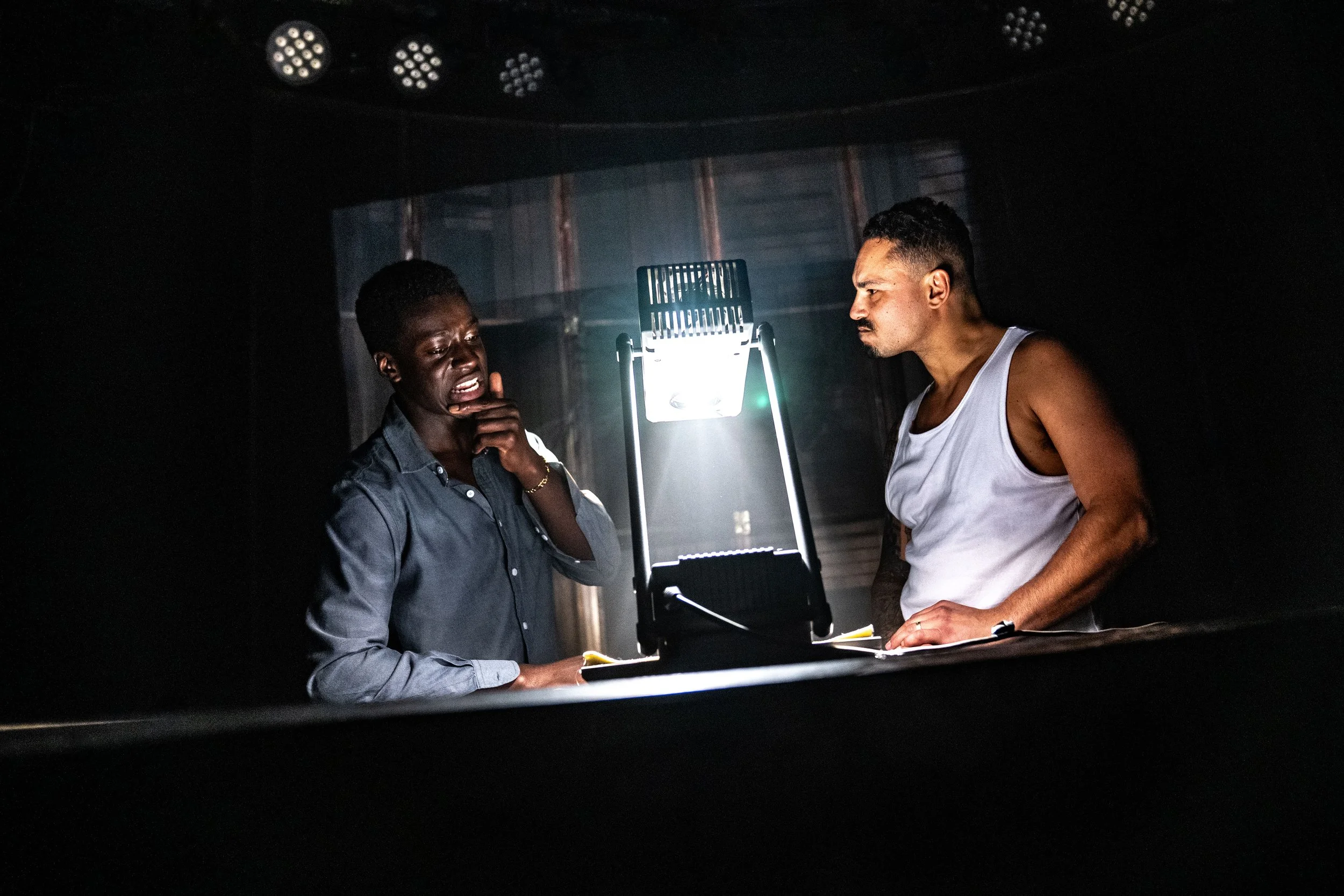
Jay Phelps delivers a sultry, soothing performance as JP, providing the soundtrack and creating what feels like a subversive sonic experience. While his acting feels less polished, his musical talent is undeniable. His trumpet work captures the essence of Davis’s sound with remarkable precision, making the abstract discussions of jazz technique viscerally real. The production successfully grapples with essential questions: What is jazz? What does it mean? As one pivotal line articulates: "If you play the blues, you have to play the feeling." The play's central wisdom, delivered by Akintuyosi, becomes JP's guiding principle: "I play who I am." The narrative charts Davis's albums alongside his personal experiences, exploring how pain fuelled not only his own life but those of his band members too. We see how being on stage and playing jazz offered escape from the lived reality of being Black in mid-20th century America.
Importantly, the play acknowledges the racialised worlds both characters inhabit. JP as a Black and white mixed-race artist navigating contemporary tensions, and Davis straddling Black and white worlds during racial segregation and heightened violence. In our current testing times, this dual examination feels particularly apt. The production also offers thoughtful commentary on the different influences shaping jazz, including African philosophies and sounds, presenting Davis as a creative strategist. Ultimately, it asks what we value musically and makes a wider statement about the place of Black music today.
Yet for all its accomplishments, MILES has notable shortcomings. The narrative's episodic structure creates pacing issues, with my emotional investment ebbing and flowing rather than building steadily. Whilst the production presents Davis as storied and afflicted, it skims over the pain he caused those who crossed his path, particularly the women in his life. The depiction feels generous, perhaps too kind to Davis and his misgivings, raising important questions about how Black men are often given favourable portrayals despite documented harm.
Still, the production succeeds in its circular mission. JP learns to play who he is, and through his understanding, we see that the music lives on, passion and personality embedded within it. The ending feels resolved, the journey complete.
MILES is a thoughtful, technically accomplished production featuring strong performances and an immersive exploration of artistic identity. Whilst it does not fully reckon with its subject's darker dimensions and occasionally loses emotional momentum, it offers a compelling meditation on jazz, legacy and the personal forces that inform great art.
★★★★☆
By Koehun Aziz-Kamara