Deep Azure by Chadwick Boseman – ★★★☆☆
Written in 2005, long before Chadwick Boseman became the cultural figure we know and mourn, Deep Azure draws from the death of a fellow Howard University student under circumstances that have since become devastatingly familiar. Directed by Tristan Fynn-Aiduenu, the play centres on the death of Joshua Smith, known as Deep (Jayden Elijah), and the world that continues without him after his murder at the hands of police. Deep is nicknamed such after his “thoughts that run deep”, something we come to understand as his girlfriend Azure reads from his journals and poetry throughout. What is striking about Deep Azure is how it is, above everything else, a love letter to Blackness.
The production opens with two beatboxing figures centre stage, joined by six more who form the ensemble and serve as the play's living soundtrack. There is no dialogue for the first five minutes, only harmonies and beatboxing. When words do arrive they are Shakespearean in structure, infused with AAVE, spoken word and hymn in equal measure. The second half in particular makes this mélange explicit: it opens with Mecca University’s band doing a rendition of High School Musical's 'What Time Is It', moving through Mario's 'Let Me Love You', 50 Cent's 'Candy Shop' and Kanye's 'Gold Digger', a deliberate and considered nod to the HBCU culture and tradition – before the ensemble later shifts into 'Glory Glory Hallelujah', 'Leaning on the Everlasting Arms' and Tasha Cobbs' 'For Your Glory'. It sounds like it should not work, the confluence of church and pop culture, and yet it does, because the play understands that these things coexist naturally within Black life rather than contradicting each other.
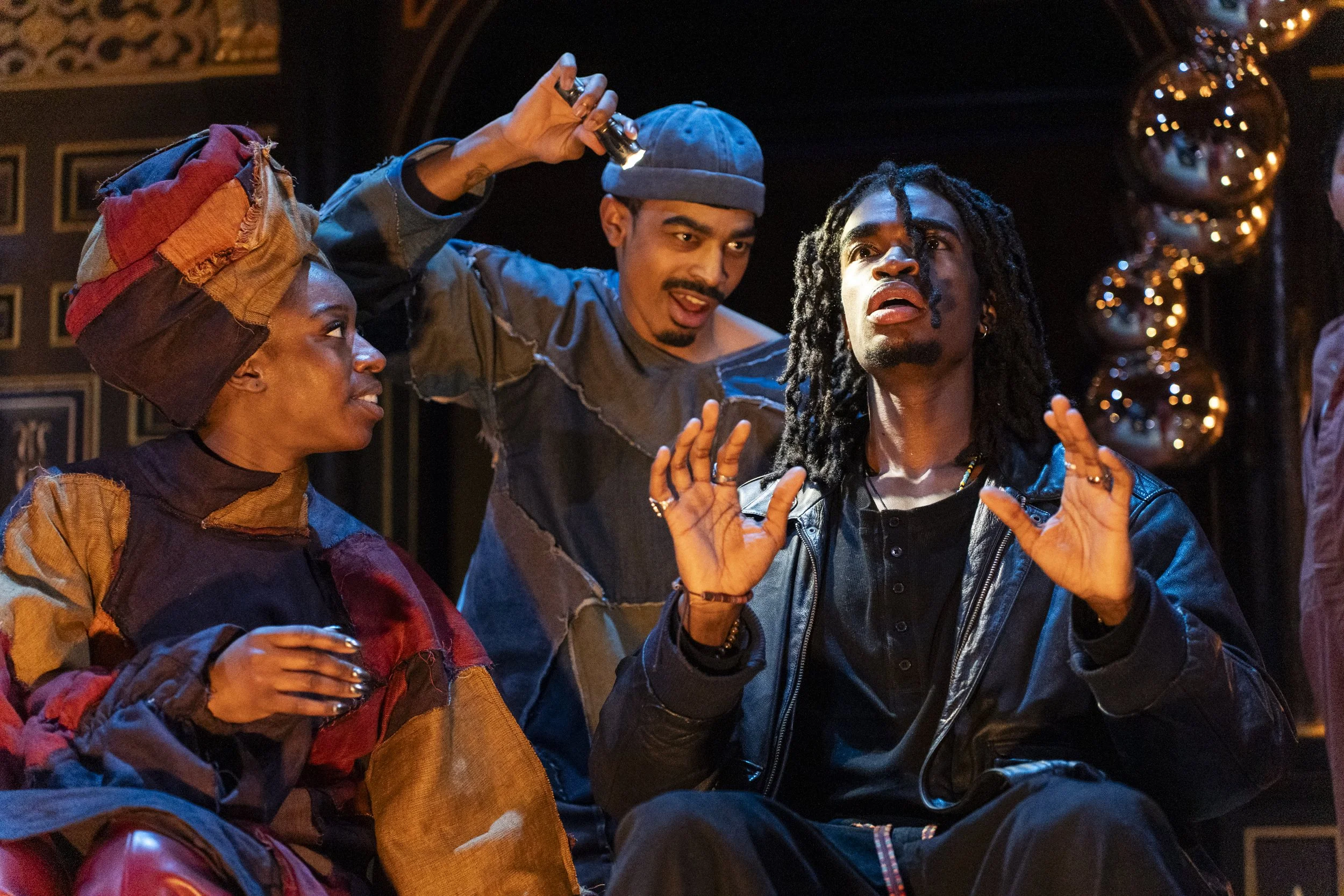
Two narrators are introduced in the first half, but it is the reintroduction in the second as Street Knowledge of Good and Street Knowledge of Evil, that sees them arrive adorned in West African style batik clothing, a costuming choice which speaks directly to the African roots of African-American identity and influence of African knowledge and belief systems in contemporary African-American life. The university at the centre of the play is a clear stand-in for Howard, referred to throughout by its colloquial name, the Mecca, which quietly reinforces the religious and spiritual current that runs beneath the entire production. Deep is a fervent believer in (the Christian) God and in fixing his community, and much of his presence in the play exists to press on questions of justice, morality and what we do when God's goodness feels absent.
Deep watches his post-death world as a spectator, and the play narrates the events surrounding and following his death whilst occasionally transporting us back into his life. It is through his girlfriend Azure that we gain the most intimate access to who he was. Azure (Selina Jones) is, without question, the star of the show.
When we first meet her she is a despondent figure amidst the chaos of protest, "No Justice, No Peace" ringing out around her. Jones brings a rare interiority to the role. Azure's struggles with bulimia, with desire, with measuring her own worth through Deep's waning sexual attraction to her, "I made his desire my barometer," are rendered with a specificity that grounds her as a fully realised person – and arguably the only one. The production asks us to mourn Deep whilst quietly revealing that his attraction to a very specific version of her body was a source of real harm, harm that Azure internalises as her own failing rather than his. It is a tension the play raises but does not interrogate, and it sits uneasily against the martyrdom it otherwise constructs around him. It is the end of the first half where Jones truly announces herself. What makes Jones' performance so remarkable is that she carries all of this, the grief, the harm, the internalised doubt, and still makes the end of the first half one of the most moving things I have seen on a stage in some time.
Roshad (Justice Ritchie) is equally compelling, bringing his character's grief to life in a way that lets you feel the loss of his best friend alongside him. He is a man navigating grief while also wrestling with the tension between faith in God and the absence of earthly justice. His arc, which builds towards an epiphany about avenging Deep's death, feels both inevitable and devastating. Aminita Francis brings warmth and impressive range across the many roles she inhabits, her singing a particular standout.

The set design rewards close attention. Candles on stage evoke vigil, and Azusa Ono's candlelight design does considerable work beyond the literal, creating an ambient atmosphere that holds the production together emotionally. The TV channel-surfing scene, in which the ensemble cuts through the unbearable tension of an impending verdict with sharp comedy, is a stroke of theatrical craft. The ensemble is absolutely brilliant in it, grounding and situating the audience within each TV show they inhabit before pulling us back to the room we are actually waiting in. Much of this is owed to Hanna Dimtsu, whose movement direction brings this scene to life and whose hand can be felt in the physical poetry running through the whole production. The doors through which the audience enters are adorned with portraits of Black cultural icons, among them 2Pac, Aaliyah, Ella Fitzgerald, Lisa 'Left Eye' Lopes and Boseman himself. Easy to walk past, but it signals exactly whose music, whose culture and whose world this play is in conversation with.
Where Deep Azure strains under its own weight is in the coherence of its many moving parts. The musical sequences and interludes, though joyful and enjoyable, occasionally overwhelm the story rather than serve it, and land differently if you come without the cultural fluency they assume. The play does not always reckon honestly with what it reveals about its own characters, and this extends further into subplots that feel underdeveloped or tonally disconnected: the web of desire and motivation that underpins the central tragedy is never quite unpicked with the clarity it needs and the central love story between Deep and Azure, which the play asks you to invest in most heavily, does not always earn that investment. At close to three hours including the interval, these gaps accumulate. Boseman wrote something genuinely vital here, and Fynn-Aiduenu stages it with evident care. The pleasure of seeing so much of the Black experience held on stage at once, seriously, joyfully and with real specificity, is not a small thing. But the play asks you to do some of the work it should be doing itself.
★★★☆☆
By Koehun Aziz-Kamara