Ego’s Killing the Mandem by Richard Adetunji – ★★★★☆
The Oxford English Dictionary has three definitions of the word “ego”, derived from the Latin term for “I”. Its general use refers to a person's sense of self-esteem or self-importance. In psychology, it is defined as the part of the mind that mediates between the conscious and the unconscious and is responsible for reality testing and a sense of personal identity. In philosophy, it is simply a conscious thinking subject. In Richard Adetunji’s Ego’s Killing the Mandem, we see Ego personified, and embodying all its definitions. Brought to life, Ego is made to stand trial for the death of one of his subjects and we see the ways that ego exists in the lives of young black men in London.
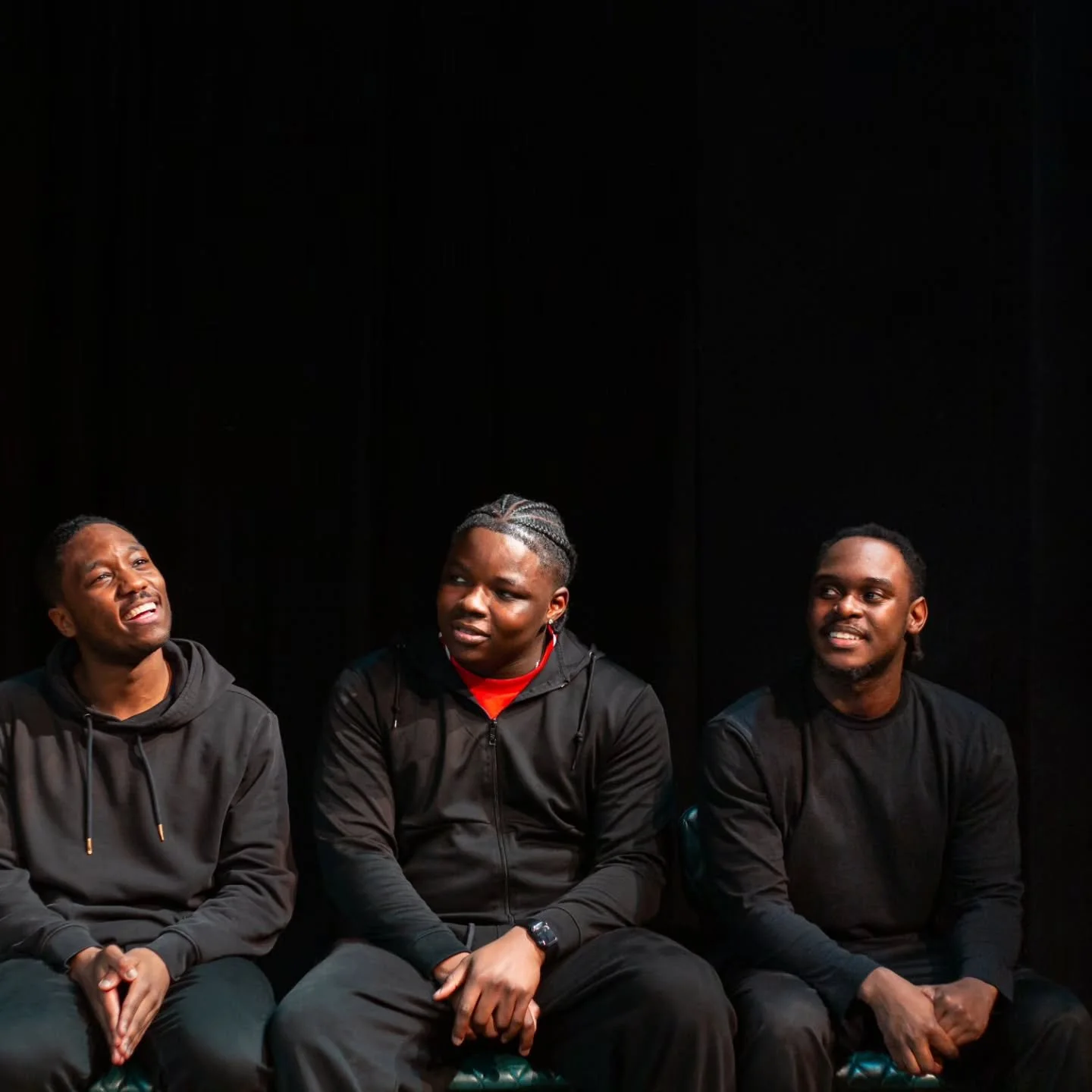
The set is simple, made up of three tables covered in black tablecloths acting as pieces of the courtroom where Seyi Falas as Ego takes the stand. He is the very image of masculinity, dressed in all black, an impenetrable expression, and a stance to match. He is joined by the prosecution (Daniel Ooko) and defence (Ibrahim Kanu), the judge played by Emmanuel Farinre and final the jury, who double as the “mandem”, played by Joshua Maloney, Pyerre Clark and Abbey Oyetunde, and this makes up our court.
The court tries to reach a verdict about the role of Ego in the tragedy that befalls his subject, referred to as IC3. Through reenactments of his final days, we try to understand what ego is, what it can make us do. IC3 is a Cambridge bound poet, who has a difficult relationship with his father, and leans on “the mandem” for distraction and community. When he becomes the subject of police harassment, the events that follow lead to an unfortunate end, and through the story we see the way that Ego’s influence interacts with external factors to shape our lives.
Adetunji’s script contains multitudes; there is poetry delivered by IC3 and Ego, that spotlight the fragility of human nature, and the beauty that can come from vulnerability. In Ego’s pleas he lays out the world of the mandem, giving to South London the same romantic nuance that Shakespeare gave to Venice, and Stan Lee to New York. In a particularly profound moment, he describes the duality of the ego, and the duality of man and how Ego encompasses the self which in turn is the best and the worst of us. When the circumstances that shaped IC3’s life were positive, Ego’s influence on his life mirrored this, but life became a series of injustice and brutality, Ego responded accordingly. The story ends with the understanding that ego is born out of need, and stays with us for as long as it will serve us, and it is subject to change, and also death in the same way that we are.
Following in the same vein as plays such as Tyrell Williams’ Red Pitch and Kwame Owusu’s Dreaming and Drowning, Ego’s Killing the Mandem offers a layered and balanced portrayal of young, black men from inner city London. The play does of course unpack the stereotypes attached to them, and doesn’t remove them from it, but it portrays ambition, humour and softness in a way that the media often fails to do. Adetunji’s script and direction draws from several influences, creating a kaleidoscopic final piece. There are scenes that feel reminiscent of Boyz n the Hood, and then there are scenes that feel like they are plucked from your favourite old school Disney Show.
The entire cast is brilliant. Each actor brought to the role an energy that was palpable and authentic, bouncing off each other and making light work of a script that had so much depth and complexity. Between sombre moments that tugged at the heart and lighter ones that brought laughter, the actors worked through a vast range of emotions and truly captured the hearts of the audience. There are parts of the play that felt unpolished, particularly towards the end. There were also parts that felt slightly like a GCSE drama performance, and the play as a whole does have its imperfections. But all in all, it was compelling and beautifully written and performed.
Powerful, humorous and poignant Ego’s Killing the Mandem is a masterclass in philosophical and sociological thought, in a bold and poetic play that really makes you think.
★★★★☆
By Melody Adebisi