Crown of Blood by Oladipo Agboluaje – ★★★★★
There is a reason Shakespeare is regarded as the greatest English writer of all time, and that his works continue to find new life in contemporary times, some 400 years after they were written. At the core of his writing is what maketh the man, what makes us human. Human sentiments and emotions are malleable and universal, and Macbeth is a play that explores unbridled, relentless human feeling. To take Macbeth then, and place it in the middle of the war that divided 19th-century Yorubaland is nothing short of a stroke of genius and Oladipo Agboluaje’s Crown of Blood does just that.
In Crown of Blood, Macbeth becomes Aderemi (Deyemi Okanlawon), a soldier who finds honour and purpose in his duties to his royal highness Kabiyesi Alaafin Iwagbala (Patrice Naiambana), to his wife Oyebisi (Kehinde Bankole) and to the people of Oyo. A river of blood runs through Oyo Empire. It's symbolised by a red cloth that cuts through the middle of the stage. Its shape shifts, it’s manipulated by the characters that wield it. We find ourselves in the midst of a bloody civil war where Aderemi has been proving himself to be a formidable asset to his army. Oyebisi sees her husband’s potential, and decides to take his destiny into her own hands. When she pays Awosika (Tunji Falana), an Ifa priest and head of the priesthood of Oyo, to tell Aderemi that the gods have destined him to wear the crown, she unknowingly sets in motion the journey to his demise.
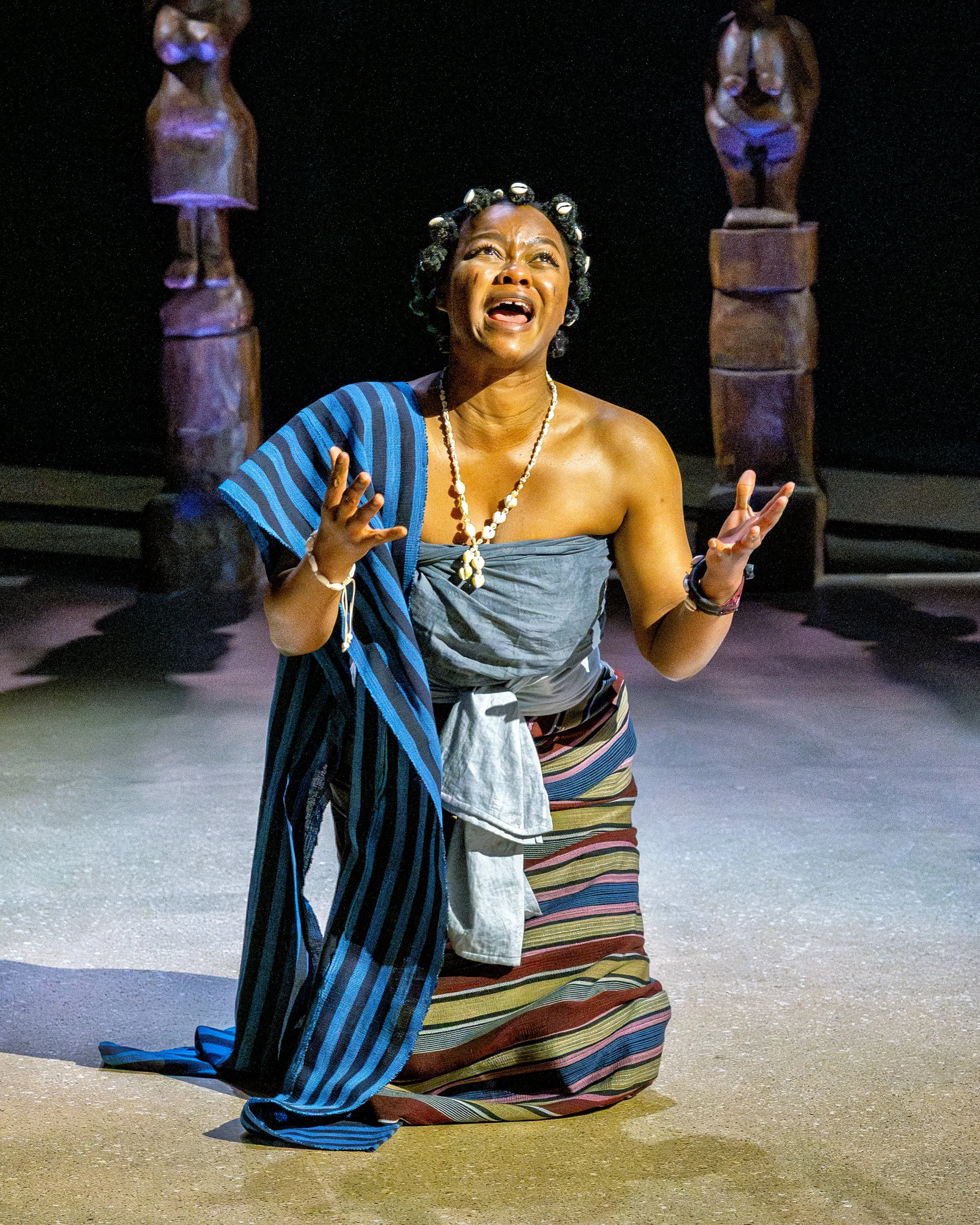
Following the same journey as Shakespeare’s Macbeth, Aderemi’s ambition is bolstered by his wife’s devotion, and the supposed support of the gods. His burgeoning success runs parallel to his hubris, as the more power he obtains the more relentless he becomes in pursuit of the ultimate goal; the crown that sits on the head of Kabiyesi Alaafin Iwagbala. Okanlawon’s portrayal of Aderemi embodies this character arc entirely. At the beginning of the play, his demeanour is one of humility and nobility, but as the story unfolds, his body and voice contorts itself into an animalistic version of the man we meet in the opening scene. His performance marries beautifully with Bankole’s as Oyebisi. Lady Macbeth has remained one of the most iconic female characters in literary history, and in Crown of Blood her character is given greater nuance and rounding. She is sultry, and manipulative but also afraid and it is fear and resentment that drives her ruthlessness. Oyebisi denounces the power of the so-called gods, declaring her womanhood a god unto itself, even when her plan ultimately fails, and Bankole performs this brilliantly.
The supporting cast and ensemble create characters that add texture, colour and humour to the Oyo Empire on the Crucible stage. They double as adapted characters from the original play, but also parts of Yoruba culture, which speaks to the intentionality of the show’s creators. Arokin (Toyin Oshinaike) plays the court historian, who documents the events of the Aderemi’s through song and narration as opposed to written text as the play takes place before Yoruba became a written literate language. The witches in Shakespeare’s Macbeth become babalawos and diviners played by Tunji Falana and Adeniyi Olusola Morolahun who communicate with the gods to pass on messages to civilians.
Agboluaje’s interpretation of Macbeth amplifies the story, situating it in the midst of a world and events that are real, but inextricably tied to the world of myth and legend. It brings to attention questions of morality, the balance between personal desire and communal responsibility, making it the perfect bridge between Shakespearean and Nigerian drama.
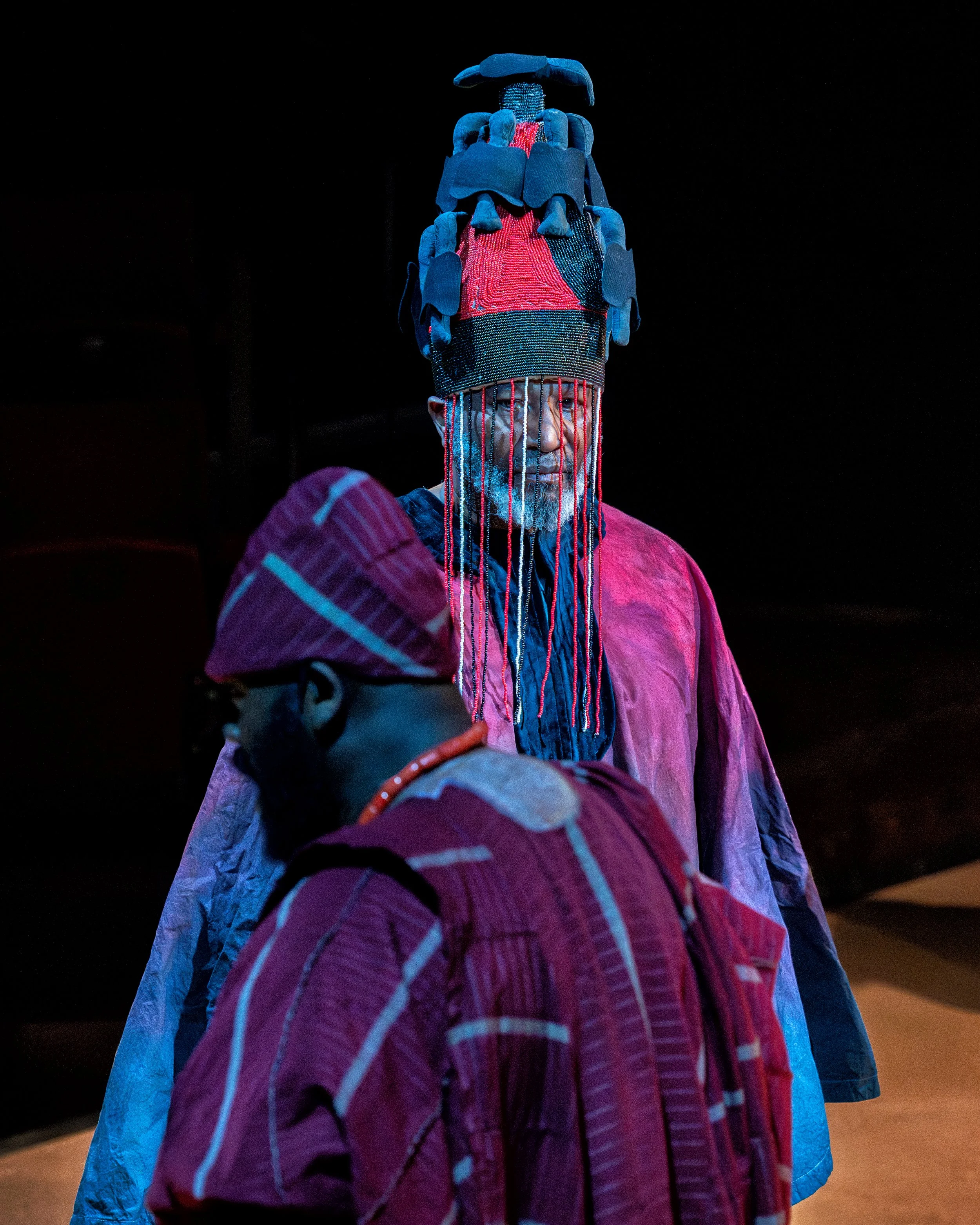
Crown of Blood evokes a philosophy adopted by Toni Morrison, about “writing for black people”. Morrison explained that in her work, she did not seek to placate the need of non-black people to understand everything that she touches on in her writing, insisting rather that her primary audience are black people, and so her writing reflects. Incorporating authentic Yoruba without translation, as well as elements of the culture such as oriki and and chant, director Mojisola Kareem chose to create a world that felt true to the people it is centering and “bringing ancestral memory to life on stage”.
Between the costumes, set and lighting work, the world-building in this production was truly immersive. Pillars made up of Ife terracotta, and the costume design for the masquerades, who at certain points became part of the set, made the audience feel as though we were transported to a different time and place. The play’s attention to detail as a whole was particularly striking. From the use of song to usher us from one season to another, and the use of costume to bestow and strip honour. To resounding applause, the actors knelt to dobale and ikunle when the play ended, keeping us in the mystical world of the Oyo empire even after the action had ended.
This reimagining of one of Shakespeare’s most impactful plays is the perfect adaptation, holding its own as an original work of art while honouring the heart of the Scottish tragedy, and deserves a full national tour.
★★★★★
By Melody Adebisi