Choir Boy by Tarell Alvin McRaney – ★★★★☆
The most formative time of a person’s life is arguably adolescence. Identity is formed in early years, but it is solidified when you lean into adulthood. Your perception of yourself and others, and the understanding of your place in the world starts to take on a less rose-tinted hue, and relationships become blurred by emotions unfelt and desires born anew. School, then, can feel like a microcosm of the world at large. For some this is life-affirming and for others it’s more complex. Choir Boy by Tarell Alvin McCraney follows five young black boys who are beginning to see the world in this way. With delicate, intricate and beautifully layered direction from Nancy Medina, we get a story of what it means to be oneself in a world that wants you to hide yourself.
McCraney, renowned writer of the Brothers/Sisters plays and the award-winning Moonlight, draws on his high school experience, one where he felt like he was forced to suppress who he was for the sake of conformity. In one of the opening scenes, Headmaster Marrow (Daon Broni) tells choir leader Pharus (Terique Jarrett) that in order to thrive at Charles R Drew, an all-black boarding school for boys, and maintain his status as leader of its prestigious choir, he must learn to “keep it all in”. Queer, exuberant and opinionated Pharus tries and struggles to do just this, while trying to manage the complicated relationships he has with his fellow choir members. We become a fly on the wall, watching the tensions wrap themselves around words unspoken and looks exchanged, as Pharus fights to maintain his position and forge a place for himself. He wants to lead the commencement at his congregation; he is gifted and the position feels like his right but he is up against the clashing personalities of the boys he sings with and a world that wants to define who he is.
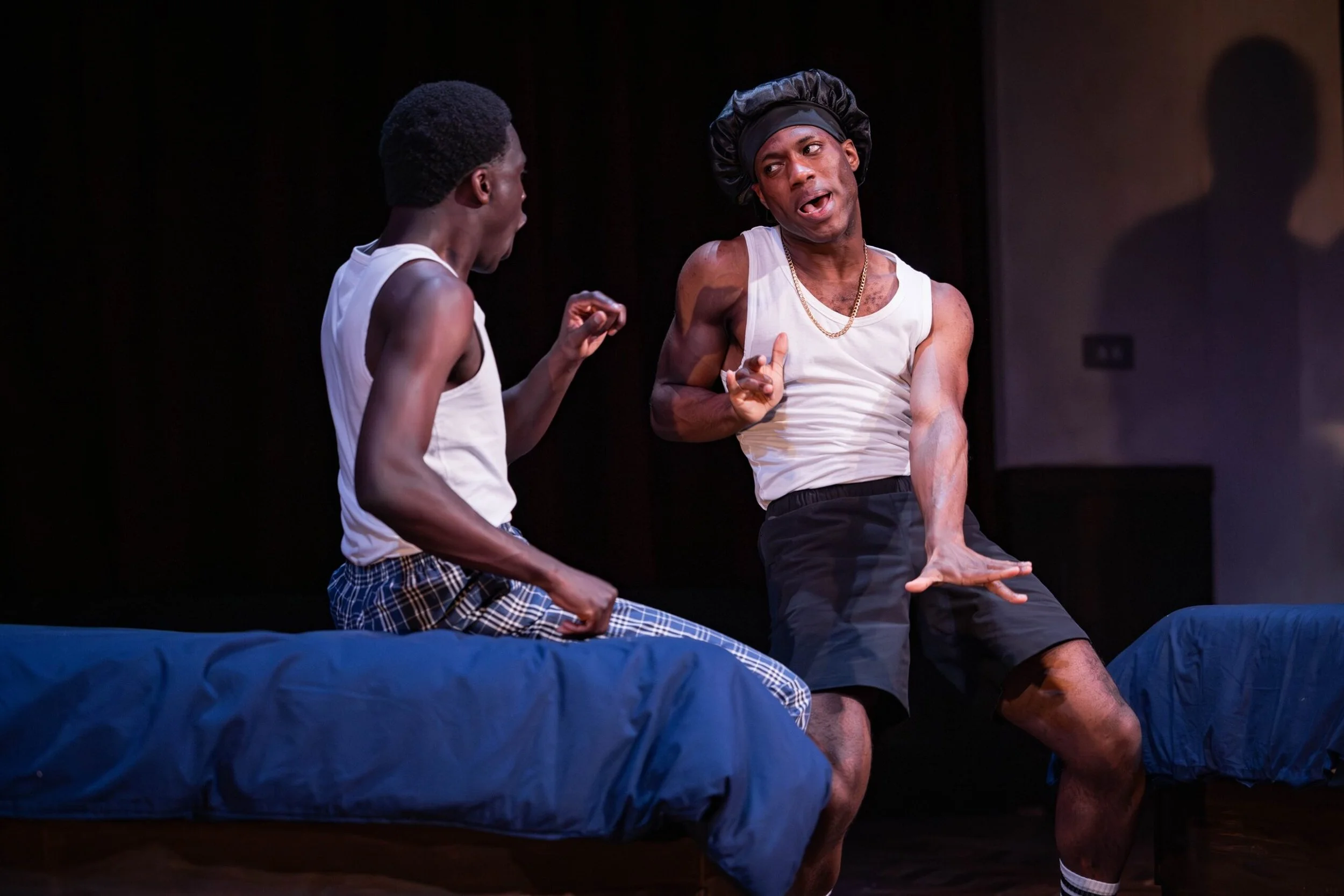
Jarrett’s take on Pharus is lively and humorous. His comedic timing is perfect, and though subtle his physicality creates a character whose authenticity is palpable. The chemistry between all the cast members is a testament to both their talent and the stunning direction from Medina, and musical arrangements from Femi Temowo. The vocals, encompassing powerful solos and the most impeccable harmonies, are transcendent and spiritual, with each of the boys having a moment to shine. AJ (Freddie Macbruce), Pharus’ roommate, is stoic and represents a version of masculinity that seems opposite to Pharus’ but AJ chooses to bring them together in an empowering friendship. Bobby (Rabi Kondé), Headmaster Marrow's nephew faces his own battles within himself, and the changing dynamics of his family, bringing with it unresolved feelings that he projects unto others. Khalid Daley as JR, is for the most part an accessory or an ad-lib to the other characters’ larger personalities, but learns to listen to and think for himself, while Michael Ahomka-Lindsay’s character David reverts into himself. Though quieter and more reserved than Pharus, David too struggles to perform the image of the perfect “Drew man”.
McCraney’s script takes a while to adjust to. The first half feels confusing, and the characters one-dimensional, as they appear as archetypes rather than fully fleshed people. There are moments where I struggle to believe the seriousness of what is at stake. This changes in the second half, where we get to see how deep the emotions of the characters run. We learn more about their lives at home and the difficulties of coming-of-age as a young black man in an old, white world. In classroom debates and through assignments, McCraney gives us critical thought on identity, competition between people in tightknit communities and making myths of our ancestors, provoking the audience to question our own biases and desires. The introduction of Mr Pendleton (Martin Turner), alumnus turned guest professor, further provokes our minds as well as the minds of the characters, by throwing existential philosophical questions into the air. It is a script that is mostly clever, complex and dynamic but sometimes light-hearted verging on vapid.
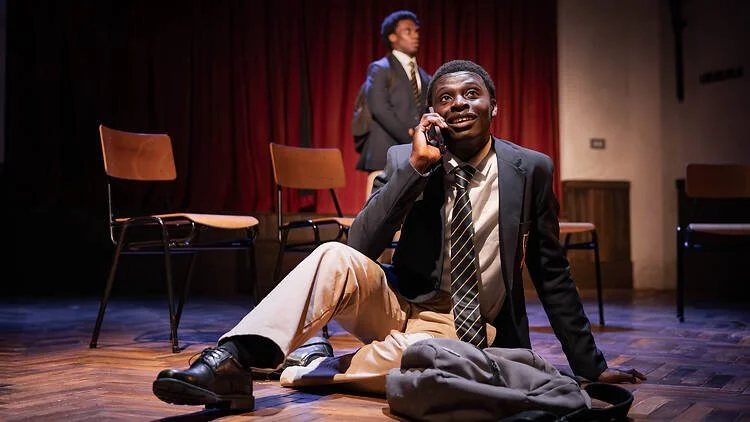
With 11.5 m of depth, Stratford East is home to the deepest stage in London making it the perfect platform for Choir Boy. For Choir Boy, the first thing we see on the stage is bright lights, basking the choristers of Charles R Drew School in their light as they begin a stunning rendition of the classic hymn Trust and Obey. It is the surface level, where the boys, Pharus especially, are able to present themselves as they wish to be seen. As the story begins to unfold, the stage starts to reveal its depth, first becoming spaces in the school including classrooms, the hall and boarding rooms, hubs for interaction, bartering and the exploring of identities, before finally it peels back its deepest layer to become the showers. A significant site of lore for the school, as well as a vital point of action for the boys. It is where they have their most intimate moments, embracing each other in pain, love, lust and anger, where they are the most bare and unfiltered. Cleverly woven into the fabric of the story, the set design complements Medina’s beautiful direction.
Choir Boy is a layered play, and one of its most compelling qualities is the journey that each character goes on. From Headmaster Marrow seeing in real time how even the best of intentions can still cause hurt, to Pharus learning how to hold his head up in the face of life’s heavy blows, Choir Boy shows what it means to live and to learn simultaneously. A play full of thought and tenderness for those who have gone without it, the cast and crew created beautiful scenes, with beautiful voices.
Choir Boy is showing at Stratford East until 25 April.
★★★★☆
By Melody Adebisi