The Search for Mother and the Making of Self.
In an exclusive conversation with playwright Martina Laird about her debut play Driftwood, Shope Delano explores the legacy wounds of motherlessness that run through the work and the Black diaspora more widely, and the courage it takes to imagine freedom when you've never witnessed it.
Produced in partnership with The Rendition, a 30,000-strong community and consultancy that spotlights Black Theatre.
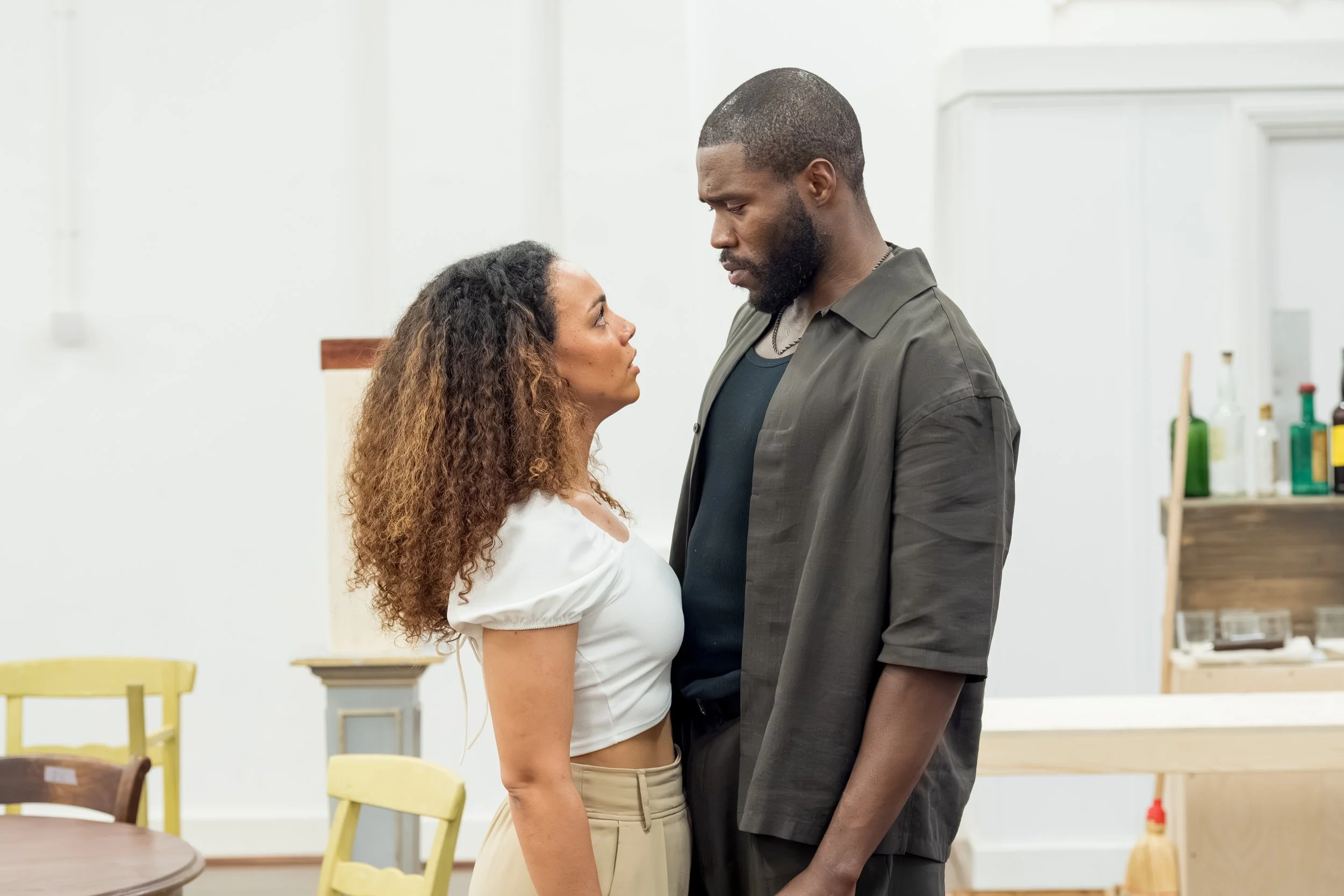
Martina Laird’s debut play, Driftwood, gives us a gift. The gift of being able to bring something that is hazy and hides beneath the surface into sharp focus. Set in 1950s Trinidad, a colonial nation on the cusp of independence, Diamond arrives in Port of Spain on a quest to locate his mother, Pearl, who abandoned him as a baby. Through high-spirited Creole dialogue, layers of deceit, and the emotional texture of a family feuding, his search spirals outward, and we observe the ways in which his motherlessness extends far beyond the immediate absence of his biological parent.
Over the course of two mid-week afternoons approximately one month apart, Martina and I spoke on the phone. A number of years my senior, the wisdom in her voice was transfixing, her energy was bountiful, and within minutes we were in it: the genesis of the play. She’d been captivated, she explained, by some research on maternal separation and the behavioural impact it had on infants. As a Trinidad-raised child of the ‘70s she was struck by the fact that these same patterns were the basis of the tropes and narratives that circled Caribbean communities, particularly about Black men and their capacity to be present, in all forms, in the family home.
As if hearing the multiple questions that sprung to my mind, a British-born child of the 90’s with Nigerian descent, Martina met me with a question of her own, posing it to me insistently, as if it demanded answer or at least spirited discussion:
“What is a mother? Who is the mother? Who is the mother from which we were all removed? And what is the impact of that?”
The mother is the root. That from which life is born. The origin point. The thing that grounds you and allows you to grow big and strong with a knowledge of who you are and where you came from. A mother gives you form, physically but also emotionally. A mother is the first to tell you that you exist, that you matter and that you belong. And the mother Martina is asking us to consider is not only biological, but also geographical and psychological.
Diamond was without his mother for the majority of his life, in the same way that countless Trinidadians of African descent were severed from their country of origin during the Middle Passage, the violent and often deadly journey undertaken by slave ships from West Africa to the West Indies. Ripped from their homes, their gods, their languages, their foods, and in many cases, their very names, these people were robbed of their root, their sense of self, and therefore their Mother, in more ways than one.
We’re talking about a severance, from the biological, geographical and psychological Mother. That is a knotty kind of motherlessness that doesn’t heal in a single generation, when our protagonist locates his mother. It is a legacy that is felt not just in Driftwood, or in Trinidad, but in all diasporic communities that have suffered under slavery and colonialism. Martina delves into this further:
“The effects of that separation lead the plot. We end up in a knot that feels inescapable because they are living out the pain of that legacy.” She pauses. “My experience is very much located in the African diasporic, but it is by no means only ours. I can only choose to be specific in my telling of my tale.”
In the specific lies the universal, and Martina wields a very pointed pen. In her construction of such a rich and circumstantial story - the entire plot unfolding in ALMA, a gentlemen’s club - she opens a wound so crusted in scar tissue without allowing us, as the audience, to bleed out. We all relate, in some sense, to the feeling of being without a Mother, whether for a short time or a lifetime. And yet alongside moments of unease and reflection, there is raucous laughter and bated breath as we revel in witty word play, and unexpected plot twists.
The rest of our Martina and I’s conversation unfolds in a similar manner - exploring the impacts of this universal wound between laughter and bated breath.
A fundamental fracture we came back to again and again, was how this cardinal separation creates a struggle for self-worth and a questioning of one’s value.
A number of Driftwood’s characters are named lustrously - Diamond, Ruby, Pearl - as if to give them a sense of inherent value and worth as they grapple with a legacy that makes claiming this deeply challenging. They work for an Englishman, Mansion, also named aptly, who is the most overt representation of this. He fails to compensate them fairly and comes to represent a colonial presence.
“Those whose lives are given over to the preservation and buoying up of a system," Martina explained, "are the ones who receive nothing from it." Being a resource for a system does not make you valuable. It robs you of your value. And the impact of that? "The characters in the play are forced into an underworld."
“How are you gonna claim dignity, if you've never seen anybody in front of you? How are you gonna, what are you gonna base it on? The same goes for love. The same goes for sovereignty. The same goes for self-determination. If you've not witnessed it, you are extremely courageous to even consider it for yourself."
Without a strong center, without a maternal mirror rooting and reflecting back their worth, a person can become unmoored. Value becomes something they must fight for, using only the tactics that they’ve been taught. And so much of the deceit within the play, is an effort to balance the scores.
"How do you progress other than through exploitation?"

And when you're on the bottom of a system, the only thing you can do is survive, another bind that Martina is deeply intrigued by.
"I have always been fascinated by the notion of survival rather than thriving. The best way to keep a system going is to keep people on the level of their survival."
"Being stuck in survival means that we have no time to truly reflect or question. Lockdown was fascinating because we had an imposed period of reflection. We could think about the world around us and how we had all been living for the past few generations."
That same reflective questioning filled the air in September 1956, when the play was set. Martina is fascinated by these ‘end-of-era’ moments when a society reaches a tipping point, and deep transformation occurs. Trinidad was on the cusp of independence, just before its second national election under universal suffrage. Dr. Eric Williams and the People's National Movement were on the verge of victory, promising self-governance.
When you speak to anyone who was around then, Martina told me, "the optimism, the hope in the air was unprecedented. It extended through politics into culture, into social structures, into thought, into literature."
Ever the optimist, I had to ask, so what do we do? What does freedom from this legacy wound look like?
"Theatre cannot answer that question," Martina begins,
"But I can tell you what it looks like to me. It looks like love, because love is so courageous. It looks like being free of fear. Within love is respect, forgiveness, understanding, and care - all those things that we are denied when we are subjected to shame."
And I would add that those expressions must first be directed inward. Toward the self. To know yourself without a Motherly reflection requires the kind of courage previously named by Martina - the extreme courage to consider something you've never witnessed. It’s a difficult journey without root, but not impossible.
And with the hope of 1956, a hope that we by God need in 2026, I’m called to the closing line of the play, spoken by Pearl: "We are what we know ourselves to be."
Driftwood is showing at the RSC from 17 April – 30 May.