Crescent Cell, Sickle Moon: An Exploration of Care and Wellness
In 2026, Crescent Cell, Sickle Moon travelled across London and Liverpool for 21 performances, reaching audiences in theatres, hospitals, universities, and public spaces. This first tour is only the beginning, with plans developing for the play's return. In a candid conversation with The Rendition, the creators of the show shed light on the force behind it, the radical act of listening and the work that needs to be done to create a pathway to wellness for people living with Sickle Cell.
There’s an ongoing debate in philosophy about the extent to which we can really understand what it feels like to be someone or something else. A philosopher called Thomas Nagel argued that it is basically impossible. We can imagine what it would be like to live in someone else’s skin, walk someone else’s walk, see through their eyes. But ultimately, we are restricted to the limitations of our own minds and bodies. Even if we woke up in someone else’s life, we wouldn’t be able to make sense of what we’re experiencing. This means we can never really know what other people are feeling; we can’t feel other people’s pain.
The closest we can come to total empathy is by listening. Listening with intention, and letting what we hear move us to action or sitting with what can sometimes be uncomfortable truths. This is the undercurrent that runs through Sickle Cell Collective’s Crescent Cell, Sickle Moon. Part of a wider project encompassing ethnographic research by Dr Stephen Hibbs, and a documentary film by Shane Telemacque, Crescent Cell, Sickle Moon is a play that invites healthcare professionals and the wider public to listen to the experiences and voices of people living with Sickle Cell, with the hopes of creating better care in hospitals.
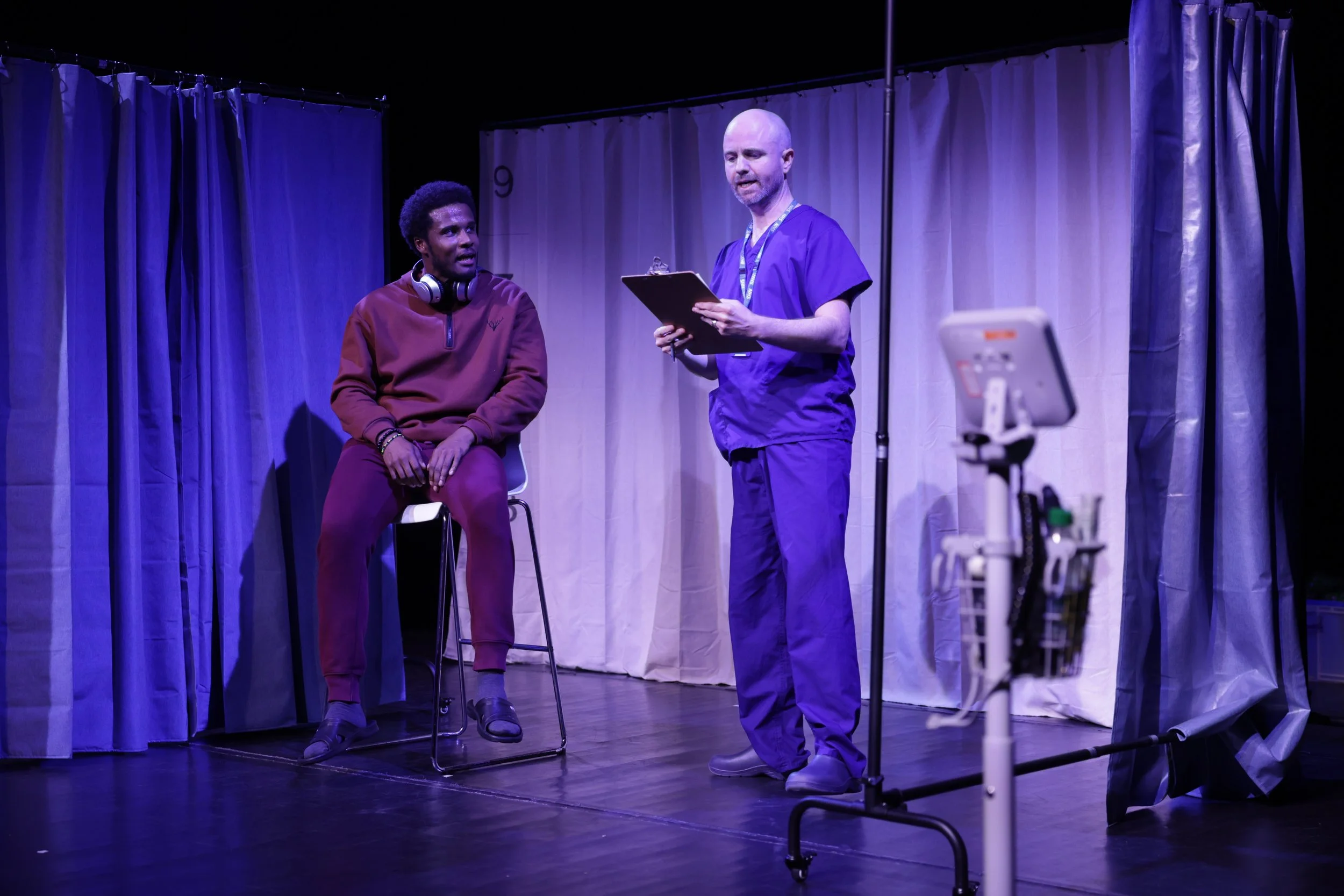
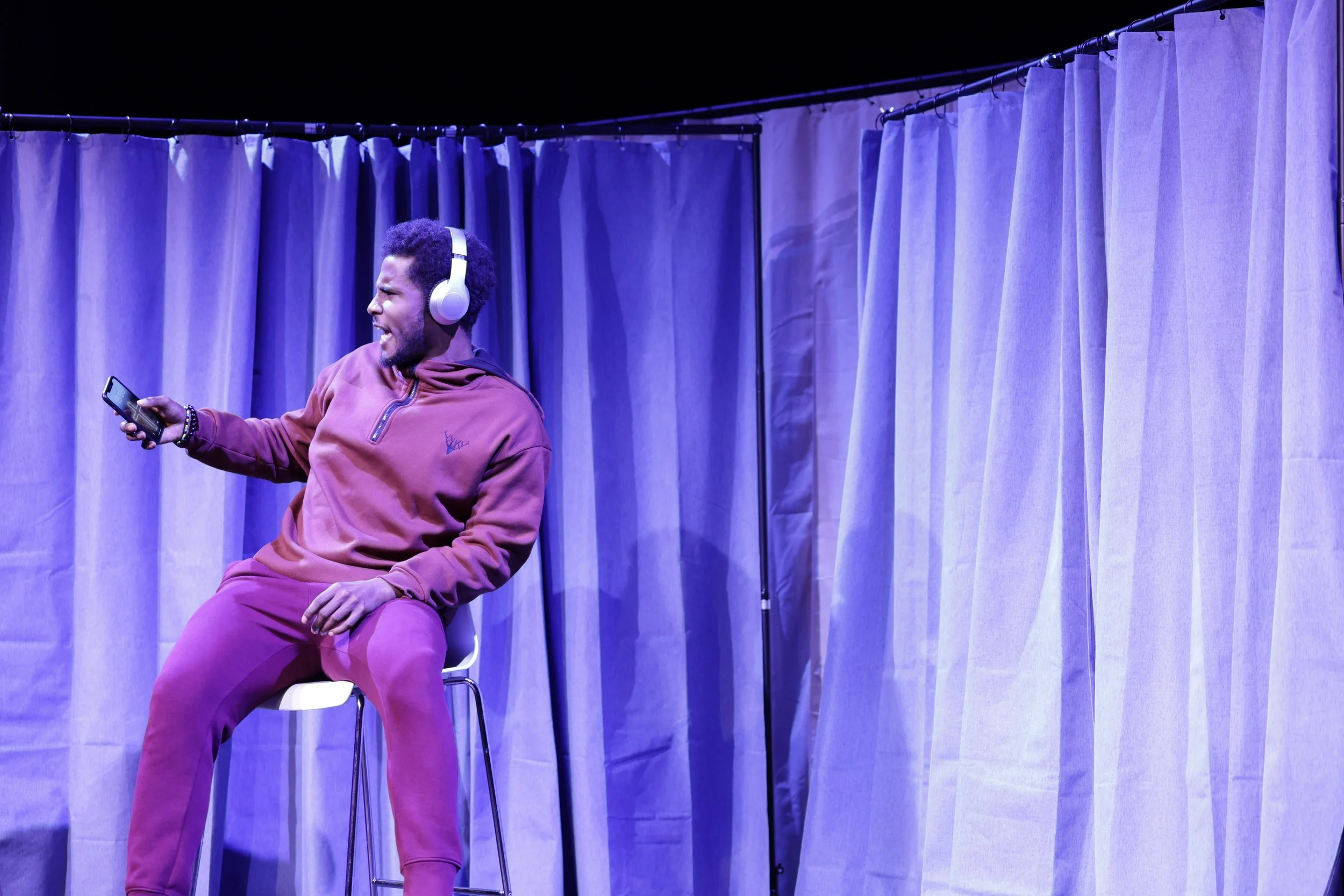
The play follows Bro, a young man living with Sickle Cell undergoing treatment. Somewhere unbeknownst to the audience, in an alternate or parallel universe where wellness is abundant and care is a given not a luxury, Sis is in an aircraft, on a rescue mission to save him. The show toured across the UK between April and May in hospitals and other medical sites as well as showing in theatres open to the general public, reaching a total of 1500 people across 21 performances.
For Mojisola Adebayo, renowned maker of theatre and playwright of Crescent Cell, Sickle Moon, her work generally starts with a “why” question.
“A question I don’t know the answer to. A question that is infuriating me, or making me very curious. It usually hints at some kind of injustice…I begin with a why question and that often leads to a what if, and that what if question is usually the premise of the play.”
For Crescent Cell, Sickle Moon, Adebayo questioned the naming of Sickle Cell itself.
For anyone unfamiliar with what Sickle Cell is, in the simplest terms, it is a blood disorder that causes red blood cells to take the shape of a crescent moon or sickle, making them hard and sticky, giving them a less straightforward path for oxygen and blood to tissues and organs. This results in severe episodes of pain known as “crises”. The pain can be unbearable, likened to shards of glass running through your veins instead of blood.
There is a common misconception that Sickle Cell is a disorder that only affects black people; it doesn’t. Whilst it does predominantly affect people of African and Caribbean descent Sickle Cell can affect anyone who carries what is known as the “sickle cell gene”. This stereotype however, the idea that it is a “black” disorder, a “black” issue, has serious implications for the perception, awareness and treatment of Sickle Cell.
The research that Crescent Cell, Sickle Moon is largely based in explores the impact of black people with Sickle Cell being neglected and having their pain and experience dismissed on a micro and macro level. This isn’t new, or even specific to Sickle Cell, it exists on a grandscale when it comes to black health issues. With Sickle Cell, though, a racialised bias is so embedded in its existence, that it is evident in its name. Sickle Cell is named after the sickle, an agricultural tool used for harvesting crops, common to countries in the global south.
This was the “why” question Mojisola used to approach writing Crescent Cell, Sickle Moon.
“Why the sickle? There’s one line in the play that says “they could’ve looked up and seen the moon, but they looked down and saw a tool.”
This “why?” soon became a “what if?”
“What if we thought of them as crescent moon cells? And what does that way of looking up, and thinking differently and looking out and listening, how does that change our perception of so called sickle cell, how might that change treatment and care. How might that change how we feel? Why and what if?
It’s a question that the play seeks to answer, and a question that Kofi Amankwah, co-producer of Crescent Cell, Sickle Moon and a member of Sickle Cell Collective, has been asking for most of his life. An actor by trade, Kofi decided against performing in the play, and instead found a different way to impart his passion and voice into the story.
“I said very early on that I didn’t want to act in it. It’s too close to home for me. As an actor, I would always be quite nervous when performing. I think those nerves were good for me…the nerves helped me to get the lines in my head, because it was a certain kind of pressure…And I didn’t want that for this, I wanted that responsibility to be on someone else’s shoulders. I know that might seem a bit cruel, but I just really wanted the best for this.”
Amankwah, has Sickle Cell, and has dedicated much of his life and work to advocating for himself, and other people living with Sickle Cell. Recalling the first time he ever saw the condition represented in the media, it is clear to see why it was important for him to be involved in making the show, and not having to perform in it.
“Me and my brother love hip-hop. We were listening to Tupac one day. At that point, I was a big fan of both Biggie and Tupac until we came to the end of the diss track. And you know the line”
Representation for Sickle Cell is rare, and is often limited to news outlets announcing new research that will supposedly change the lives of all people living with Sickle Cell, which more often than not turns out not to be as groundbreaking as reported. For Amankwah and other people with the disease, the cycle of disappointment following excitement is exhausting, and the desire for better, wider and more varied representation is potent. This, in part, is why he was determined for Crescent Cell, Sickle Moon to be a story for the stage.
“Out of all artforms, theatre can be the most impactful. It can really get to the emotions of the people watching, more than TV, film and sometimes documentary. I really wanted to do something that had me thinking outside the box. Everything else has been tried, right? I don’t know of anything done in this form for these reasons, and I think that done right, it could really have a massive impact.
Crescent Cell, Sickle Moon joins a small, but slowly growing list of stories that have Sickle Cell as part of their world; an important feature in the lives of the characters who live with it but not the entirety of their identities.
In 1973, Sidney Poitier produced and starred in A Warm December, a romantic drama film about a man who falls in love with a woman who has Sickle Cell, who is in the “december of her life” but wants to embrace their time together; a seminal, uplifting romance that Adebayo recommends to us both. In 2024, Matilda Feyisayo Ibini’s Sleepova was nominated for an Olivier, a play with a central character who has Sickle Cell, which is an important and derailing aspect of her life, but not its focal point. The most prominent though, came in the same year, in the form of Rapman’s superhero series Supacell hit Netflix and found rightful global acclaim for being a fresh take on the superhero genre, and raising awareness about Sickle Cell.
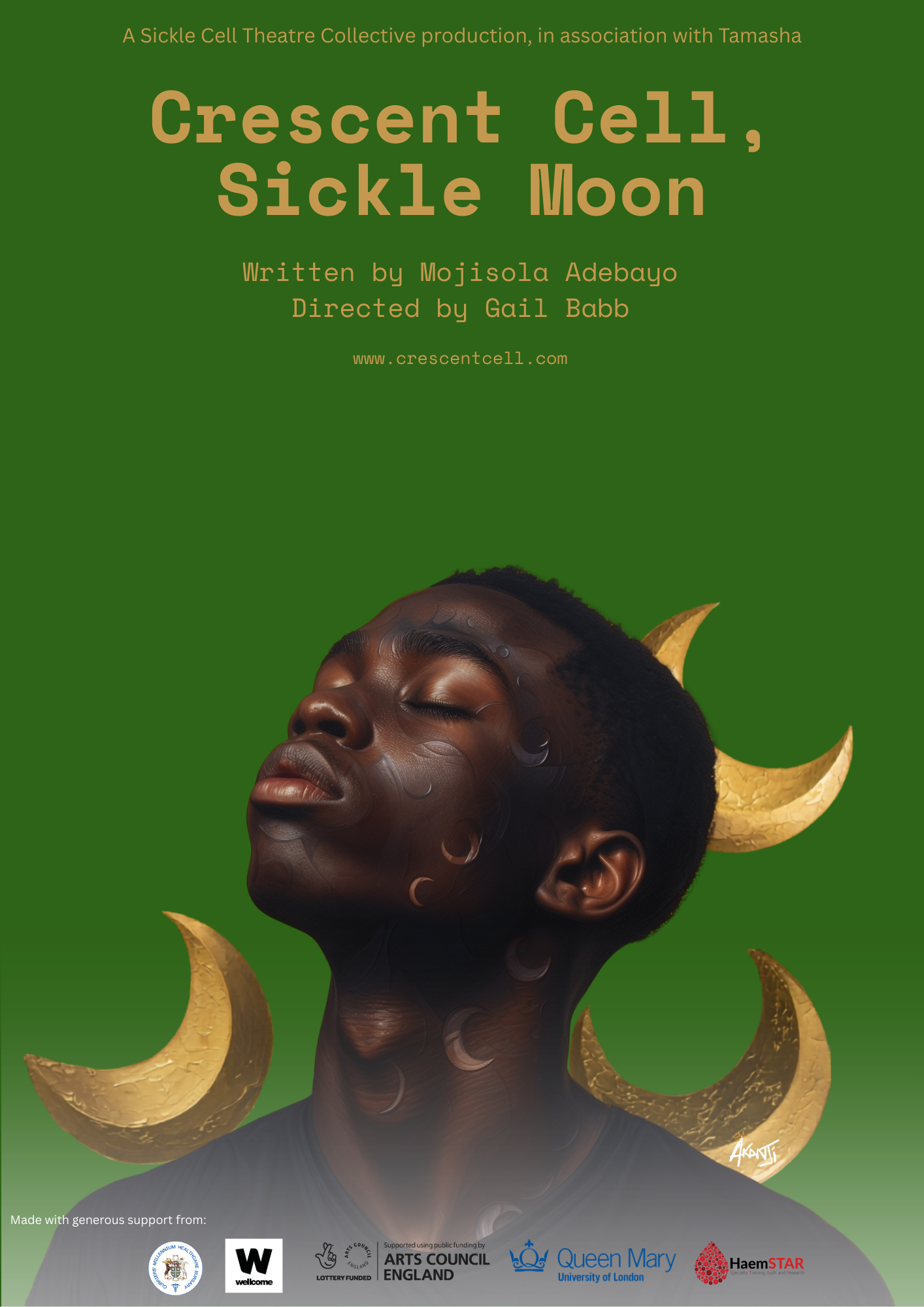
Supacell doesn’t shy away from the realities of Sickle Cell, and instead sees its characters in a world where the uniqueness of their genes sets them apart, and allows them to navigate the world in a different way, one that lends itself to greater empathy and understanding for others, and a completely inimitable perception of time. This desire to place the lives of people with Sickle Cell in imagined realms, where reality is altered isn’t limited to Supacell, you can see it in the artwork of Rizzy Akanji, an artist with Sickle Cell, whose art depicts beauty and resilience through the pain that he and others experience. His art is heavily surrealist and afro-futurist, and was used for Crescent Cell, Sickle Moon.
When I ask Adebayo why she thinks that art about Sickle Cell veers towards alternate and imagined realities and she says that in writing Crescent Cell, Sickle Moon, or thinking about the experience of black people, there is a desire to think outside of the frameworks that already exist.
“To start looking away from and up, and try to imagine something better. I think afro-futurism allows you to imagine beyond the confines that we’ve been put into. It also brings a possibility of much more joy, and playfulness, and light and colour, and uplift and dignity.”
She also touches on the realities of living with pain, and the need to transcend past it.
“The experience of pain transitions you to a different place, a different realm. A needing to go somewhere totally different because the reality of that pain is literally unbearable, to go somewhere, to transcend somewhere in one’s mind and one’s imagination if one can.”
The voices of people living with Sickle Cell have often been silenced or ignored by healthcare structures that minimise the experiences of people suffering from pain that seems specific to black people. For Dr Stephen Hibbs, a haematologist and one of the co-producers of the play, this is just one of the motivations that spurred him to make the shift from medicine to social sciences and conduct an ethnographic study “Exploring practices of care during sickle cell crises” and to partake in the show.
As a haematologist dealing with Sickle Cell Dr Hibbs recognised that a lot of his work wasn’t just providing medical care, but also coming up against structural violence, and dedicated a good portion of his career to tackling that.
The idea for Crescent Cell, Sickle Moon was largely inspired by a conversation between Amankwah and Dr Hibbs.
“The whole piece of research is trying to bring to a fuller vision of the lives of people living with Sickle Cell, in the hospital system that they are finding a way through. With theatre, there’s something about being in the same room as someone, breathing the same air, that makes it impossible to resist the moral power of that experience. Making the play also became a way for me to get to the answer of my research question - what does good care look like - that I couldn’t get to through any other means.”
Watching the show, there is something penetrating about seeing and hearing the real life experiences of people living with Sickle Cell, presented through a mixture of beautifully crafted dialogue, and raw, unadulterated accounts of pain. The play makes sure to encompass the fullness of the lives of Sickle Cell patients, making us laugh, making us relate and making us hope. It’s not pity you feel, but a deep resonance. The play encourages you to listen, and then invites us to imagine a path to wellness, one that seeks the best duty of care for people living with Sickle Cell.
Above all, it is a call to action, and this is the resounding sentiment that Amankwah wanted audiences to leave with.
“What you’re looking at is a screenshot or a moment of time, in many patients’ lives and experiences. This is a real experience. I often ask nurses, and sometimes doctors, if they think that they’re really helping, and if they answer I ask them a follow-up question; do they care if they’re helping or not? And that’s the one they normally don’t answer. Because there’s a difference. I just want people to take away that this is real and it has to change. Something has to give.”
There is a lot of work to be done, and some ways to go for Sickle Cell and the care necessary for people living with it, but Crescent Cell, Sickle Moon and the force of people behind it have created something that holds weight and gravity. More than a brilliant play, with amazing performances, it is a rallying cry to practice radical empathy, and a show that we hopefully see on stage again soon.
Crescent Cell, Sickle Moon is produced by the Sickle Cell Theatre Collective in association with Tamasha, and generously supported by funding from Arts Council England, the Wellcome Trust, Queen Mary University of London, the Curriers Millenium Healthcare Bursary, and HaemSTAR.