Splintered by Emeka Diamond – ★★★☆☆
The Biafran war is the greatest devastation Nigeria has witnessed since its birth as a colonial invention. It tore lives apart, and became evidence of a division the nation has never really recovered from. We often see stories about the divide it created between ethnic groups, political and cultural lines drawn into stone. But there are less stories about the friction between people who are seemingly on the same side. In Splintered written by Emeka Diamond and directed by Isabel Steuble-Johnson, we meet Ade (Gwent Odai) and Tolu (Daniel Abeshin); two best friends from the same village who find their lives torn apart by the Biafran war, and have to face what is left of their bond on the other side of the war.
A cloth hangs at the back of the set, black white lights are shone onto its front, the lines partitioning to create a semblance of the Nigerian flag. To its side a projector sits on a table, beaming images of Nigerian landscapes, from a birdseye view, onto a small screen. Centre stage, we get a closer look at what takes place on the ground. Tolu and Ade are on the brink of events that will reshape life as they know it.
The characters are opposites in temperament. Ade has a seriousness that makes him blind to the ever changing nature of life, and has a steadfastness that sets him apart from Tolu who, though contemplative, seems to adapt to ebbs and flows of life, his mind more wired to freedom. Both performers are passionate, displaying emotional depth and allowing their characters to evolve with the story. As young teenagers dreaming of their futures outside of the village, Ade as a shotput champion putting Nigerian athletics on the map, and Tolu as a high-flying journalist breaking the biggest stories, the young men have a naivety that changes when the Biafran war takes hold of their country.
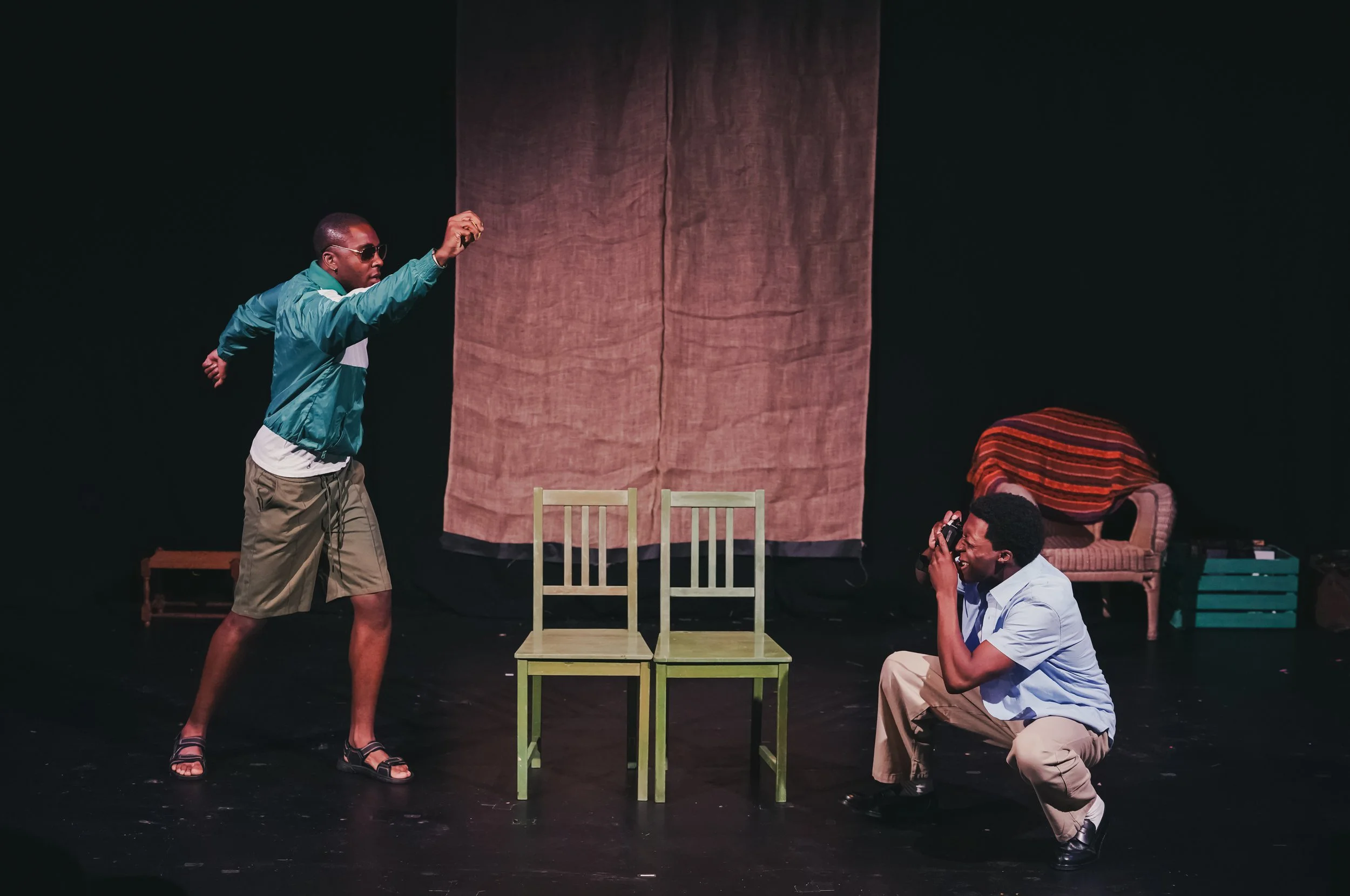
The show interpolates scenes from a time that feels lost to the memories of the war’s victims and survivors, and this is one of the play’s strengths. Clips of Emeka Ojukwu become part of interviews Tolu writes, cementing the story in the reality of the climate. The hopes and dreams of Ade and Tolu belong to a Nigeria that no longer exists, and Diamond writes this convincingly. Ade and Tolu find themselves at odds when the war seemingly propels Ade into career success, while Tolu’s olympic dreams are stalled due to what feels is discrimination. The latter resorts to joining the armed forces of Nigeria against the Biafra, which severs his relationship with his loved ones.
The tension that exists between Yoruba and Igbo & Biafran people is portrayed in a balanced, yet honest way. The play also touches on the lingering impact of post-war PTSD, and in these scenes Abeshin puts on a powerful display. Ade and Tolu, both being of Yoruba descent, offers an interesting perspective, as it eliminates the idea that the Biafran war was simply one culture versus another, and rather shows the complexities of war politics and intercultural conflict. Diamond doesn’t play a blame game, and rather creates a space for everyone’s stories to be told.
Despite this, Splintered feels somewhat incomplete. The play builds up to what the audience feels is going to be a mighty crescendo but instead, the action stalls and we are left with dialogue that rushes past subjects that feel quite pertinent. The play’s run time sits at just under an hour but feels longer, and I leave the show feeling like there was a lot missing.
Splintered is a story that has a lot of potential, with compelling characters and a complex, layered subject matter and story. Overall the show felt slightly underwhelming. However, its intelligent compilation of history, cultural sentiment and capacity to generate discussion that in turn creates opportunity for empathy and critical thinking all work in its favour, a credit to the show’s talented cast and crew.
★★★☆☆
By Melody Adebisi
Splintered will be showing at Riverside Studios until 23 August