Our Eyes Looking for God by TD Moyo - ★★★☆☆
The dreams of black boys from the deepest parts of big cities are formed under lampost trees, in football cages, in the passenger seat of a best friends’ car. Dreams comprised of hopes of escape, what a life outside of the world they know it might look like, a life without limits. One where they can be beautiful, seen for the best parts of themselves, and allowed to explore the world how they see fit. In TD Moyo’s Our Eyes Looking for God, we see Black British boyhood through the lens of two Merseyside cousins, whose lives rush against the shores of self-fulfilling prophecies. Fusing hip-hop and opera, Our Eyes Looking for God is a story about black Britishness, the space between your dreams and realities and the power of brotherhood.

Photo credit: Danny Kaan
Adjani (Gamba Cole) and Kamal (Themba Mvula) are cousins from Toxteth, but they live and breathe like two souls and bodies separated at birth; brothers in everything but name. The stage is like a dreamworld, lampposts twisted into a macabre tree, a skeletal Vauxhall Astra and patterned lighting that swirls on the ground. It feels like we are underwater, seeing the world through aquatic eyes. The band sat at the back of the stage in front of a cloth draped across the wall, images of the lives of two young black boys projected onto it at intervals during the play. The effect gives the show an essence of surrealism. When the “Caspers”, (Amari Defreitas-Smith, Ibrahim Kanu and Josh Latunji) three fate like ghouls dressed in black nylon tracksuit and bedazzled balaclavas who narrate much of the show through dance appear, they set the tone for Adjani and Kamal’s tale. Amanda Mascarenhas’s set and costume is all-consuming, and creates the perfect image of working class inner-city culture, and making it abstract.
The alchemy of Cole's rhythmic flow, and Mvula’s incredible vibrato and tenor vocal, shows both their bond and also the stark differences between the two characters. Adjani is set to move to London, and is met with hostility and judgement from Kamal, whose identity is tied to the streets of Toxteth itself. Adjani, younger and more impressionable, seeks to define his own identity, separate from his town, his mother, his wider family and cousin for fear of never finding himself, while Kamal fears the unknown. Both performers have a level of comfortability with each other, which makes the divide between them feel significant. Cole is consistently energetic, and emotive, coming in and out of his own narrative, assessing himself and his relationship with his cousin from a birdseye view, joining us in the audience to observe how the story goes down. With direction from librettist April Koyejo-Audiger, the power of Kamal’s story is delivered with Mvula’s passion and impeccable skill. Whilst his characterisation of Kamal sometimes feels slightly awkward, his ability to shape the narrative with his voice, and set the tone is truly amazing. This accompanied by Luke Bacchus’ band makes the entire performance atmospheric and immersive.
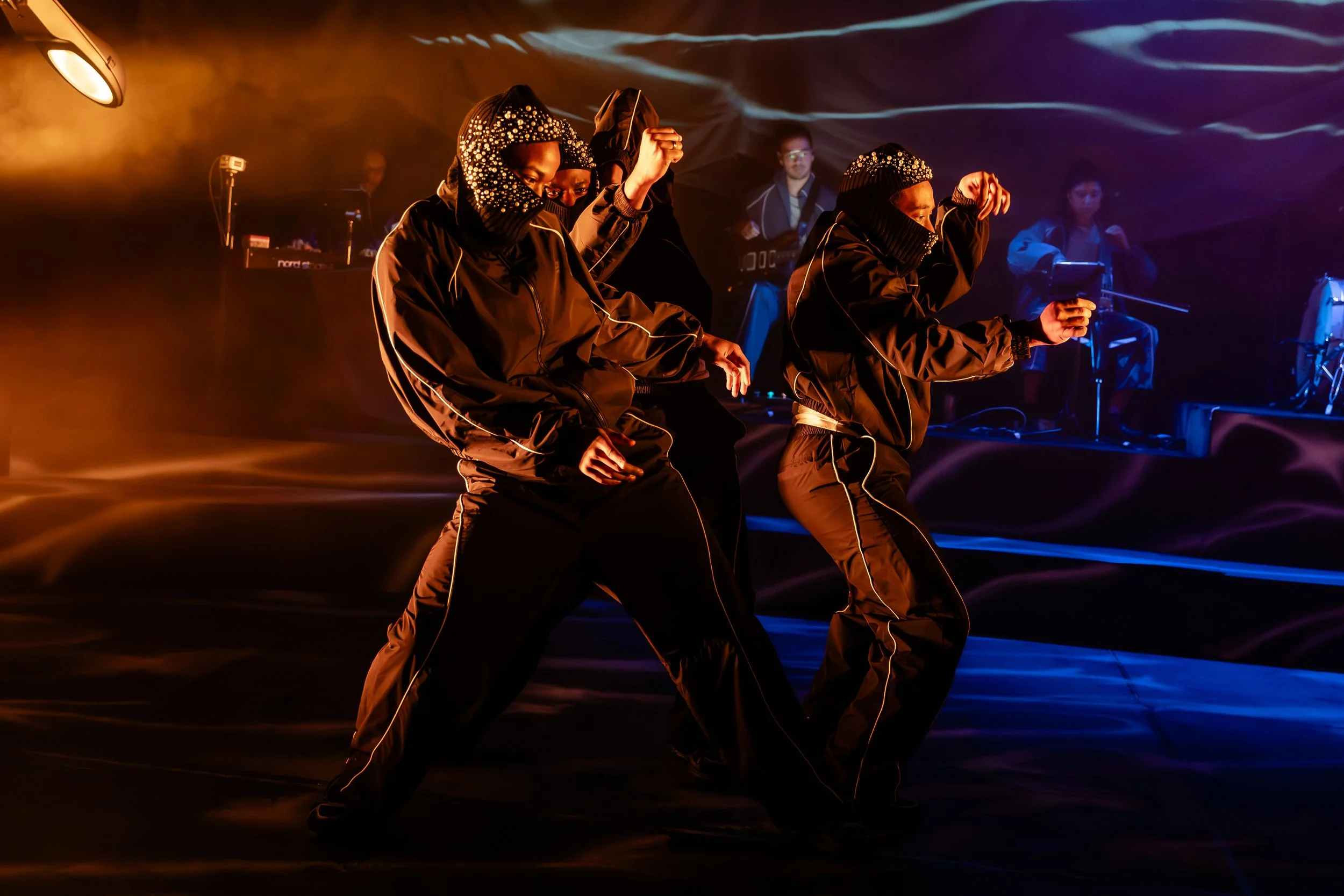
Moyo’s script touches on various aspects of black boyhood within the context of working class Britain, written with beautiful delicate prose that allows us to see inside the mind of Adjani, and occasionally through Kamal’s. Where so much of mainstream culture pertaining to blackness in the UK feels London-centric, she takes us deep into the heart of Liverpool and shines a light on the black experience in the North West. Going between masculinity, self-preservation, toxic family members and male relationships, Moyo covers a lot of ground, but at times the conversations feel incomplete. Set in 2020, against the backdrop of the peak of the BLM movement, the show ends with a truly heart-wrenching scene depicting police brutality rooted in anti-black racism. While powerful and poignant, it did feel as though the audience was blindsided with the tragedy. There is subtle foreshadowing throughout the show that the fates of the characters are in limbo, but the last 5 minutes of the show presented a massive tonal shift, and felt out of place.
Our Eyes Looking for God is a poignant spectacle, explosive, and highly original. A letter penned to black Britishness, letting it know that it deserves a stage for diverse stories to be told. Moyo’s show is layered, thought-provoking and creative, and though imperfect, is a one of a kind experience.
★★★☆☆
Melody Adebisi