In April 2014, Boko Haram, an Islamist militant and terrorist organisation, abducted 276 schoolgirls from their school in Chibok, north-eastern Nigeria, sparking international outrage and the #BringBackOurGirls campaign. Against this devastating backdrop, Girls was written by Theresa Ikoko in 2016, and ten years later it has found its way to the the Young Vic under the direction of Ewa Dina.
Starring Hannah Akhalu as Tisana, Sewa Zamba as Ruhab and Tara Tijani as Haleema, whose witty and soulful performance makes her the standout, the play initially appears to offer a simple, familiar and wholesome exploration of female friendship. At its core is the collective joy, pain and suffering women share, alongside familiar conversations about their future hopes, dreams and curiosities surrounding marriage, sex and more. There is an eerie presence beyond this playful surface, that hints at the darker examination of manipulation, morality and misogyny. As the play unfolds we are forced to address the ways in which different people react in either fight, flight, freeze or fawn when they are confronted face to face with extremism.
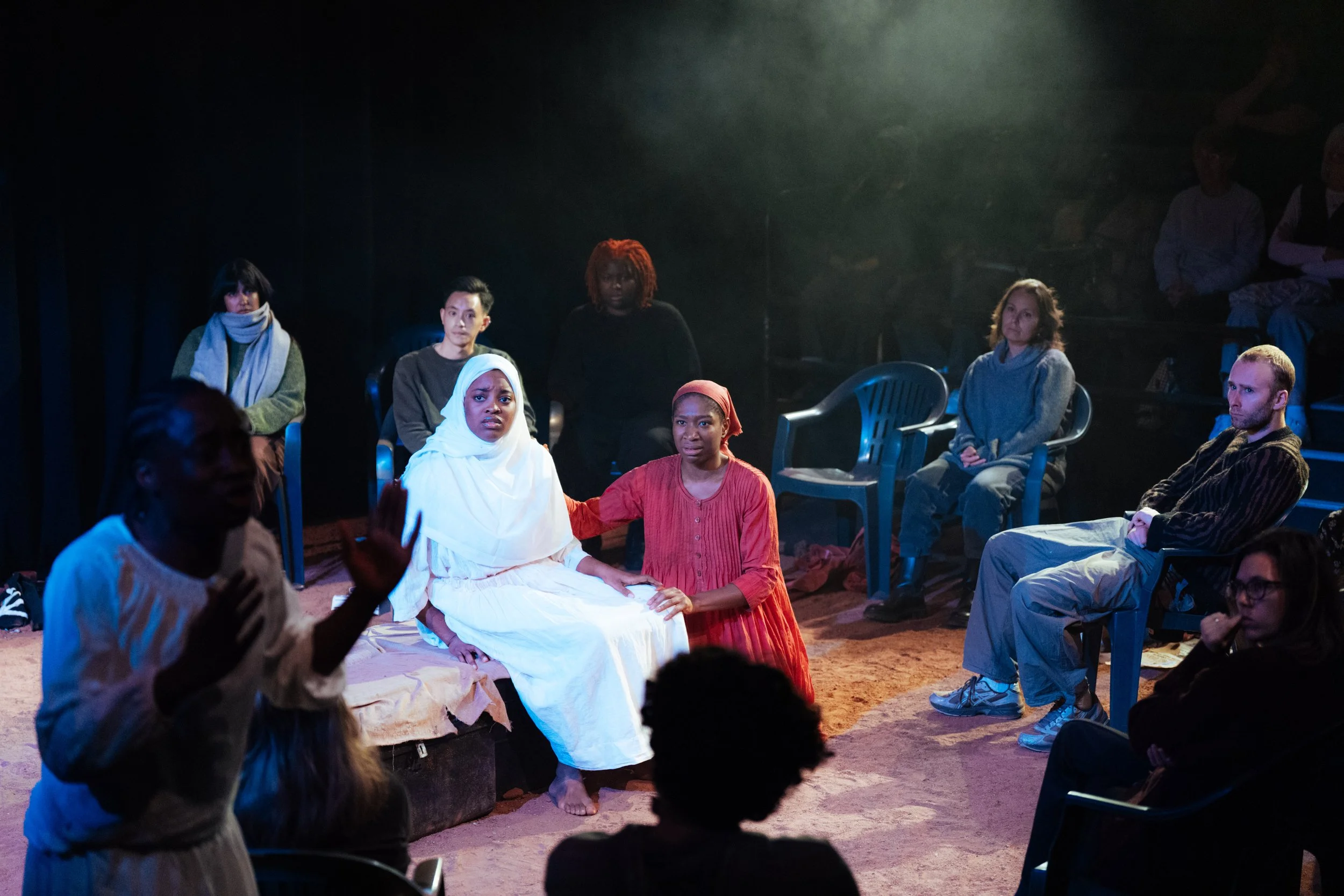
The production opens with a thumping, rhythmic dance sequence, accompanied by colourful, club-like lighting that establishes an energetic atmosphere by Lighting Designer, Elliot Griggs. Raphaé Memon’s set and costume design is equally striking yet sparse: reddish sand covers the square centre stage, while a metal frame hangs above, draped with what appears to be crumpled, charred, red clothing, likely symbolising all the missing, lost and murdered girls. Downstage, a thin black curtain conceals a row of working retro televisions that are used throughout to change the setting of the play.
The dialogue in the first scene is playful, with humorous euphemisms for jokes bouncing from girl to girl including referring to one of their friends’ genitals as a “bottle opener”. This light-hearted humour is gradually overshadowed by the loud explosions, as the sinister reality surrounding them unravels. The contrast between the ordinary rhythms of female friendship and the brutality of the play’s wider extremist captive storyline is one of its most compelling features.
As the narrative develops, Girls reveals itself to be more than a play about abduction and survival, exploring profound questions of faith, conviction and self-preservation. Tisana, a devout Christian and pastor’s daughter, refuses to participate in the Islamic prayers imposed by her captors, risking further violence rather than compromising her beliefs. Ruhab, by contrast, chooses to engage with her captors’ ideology, seeking meaning within the confines of her circumstances. Both decisions invite difficult questions about faith, autonomy and survival: is holding on to your beliefs an act of courage, or a dangerous luxury when the consequences may be physical suffering or death?
Through brief discussions of Christian and Islamic theology, they discuss how a just and merciful God could not inspire Boko Haram’s atrocities, nor condemn someone for outwardly abandoning their faith to survive. Compliance may demand more than physical submission; it may mean surrendering a part of their spirit. By suggesting that the captors seek to control not only the girls’ bodies but their souls, Girls confronts the tension between conviction and self-preservation without offering easy answers, and it is this ambiguity that makes the play so powerful.
Despite its powerful themes and emotional performances, Girls occasionally feels unnecessarily elongated, with some scenes losing momentum. Perhaps this reflects the girls’ seemingly endless wait to be liberated and seen as autonomous beings, but this intention doesn’t always translate effectively on stage.
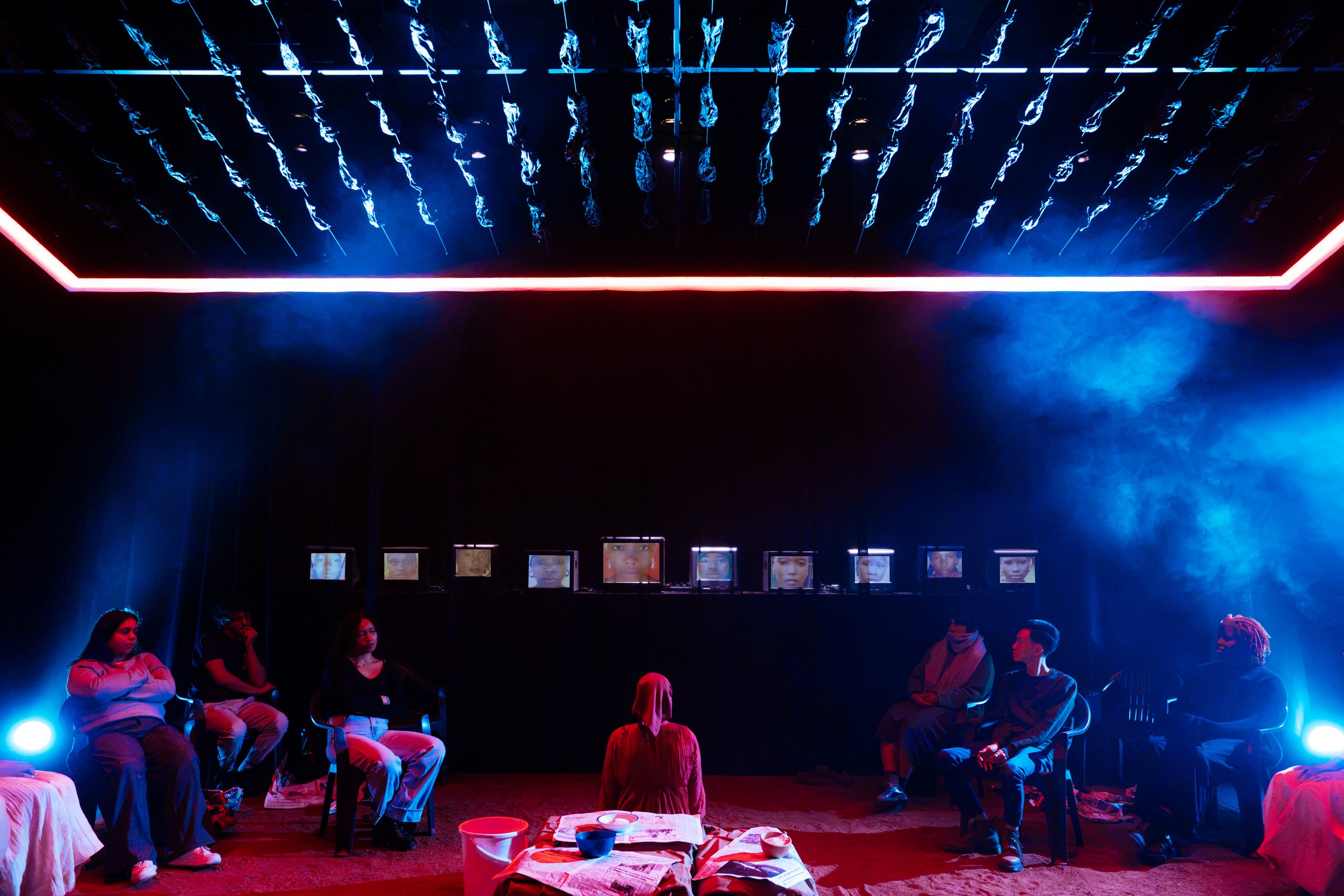
The closing scene is undoubtedly the production’s most powerful moment. Images of the Chibok girls appear across the television screens, transforming an otherwise misplaced piece of set design into a sobering reminder of the real lives behind the play’s storyline. Having witnessed the characters’ friendships, desires, convictions and fears, the audience is confronted with the reality of each individual who suffered at the hands of Boko Haram. It is a haunting conclusion that lingers long after the curtain falls, with audience members visibly fighting back tears long after the performance ended.
Ultimately, Girls is a thought-provoking play that explores survival, faith and moral compromise. Its emotional depth and powerful message make it a compelling production, even if its execution occasionally falls short of its potential. Its closing moments remind us that Black bodies experiencing trauma should never remain as yesterday’s headline. Women are disproportionately vulnerable to exploitation during war and under extremist regimes, and when racial and gender inequalities intersect, the wider Western media is too quick to forget the faces of those who suffer. Watching Girls is an opportunity to honour the Chibok girls who were abducted, acknowledge their suffering and ensure that their stories are not forgotten, but memorialised through theatre.
Girls is showing at The Young Vic until 21 November
By Nadia Mantock
★★★☆☆