THE RENDITION MEETS TEMI WILKEY
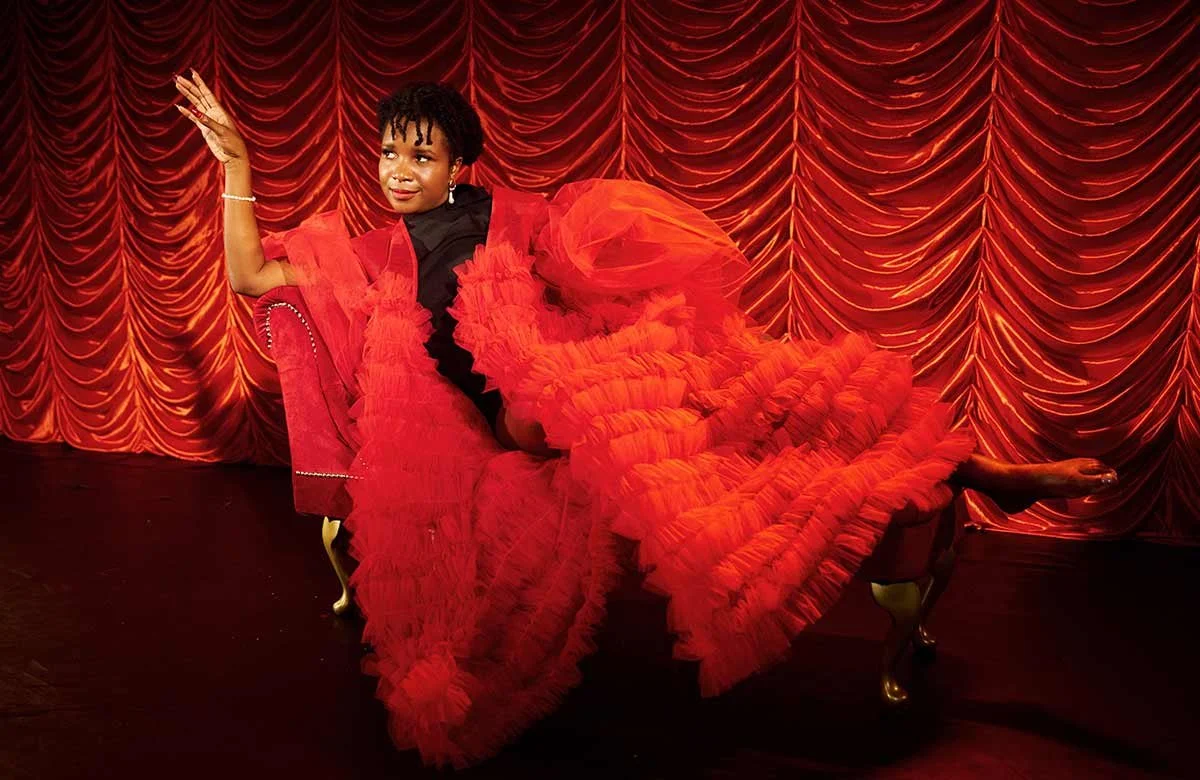
Image Credit - Jonny Ruff
“Some people make it hard, with me that isn’t the case/ I make it so easy to fall in love”
Temi Wilkey: LOVER GIRL is the title and manifesto of Temi Wilkey’s new one woman show, all in one. Part cabaret, part standup comedy-show, part musical, part monologue unmatched in vulnerability and openness, Temi tries to figure out why, despite being the epitome of a “LOVER GIRL” she is still single. Starring Temi as a fictionalised version of herself and featuring her “Infinity Pussy” aptly named because her “pussy is so infinite has its own gravitational pull”, we journey through the history of her romantic relationships, the discovery of her queerness, the odyssey she braves to open up her heart, and inner musings of her “Infinity pussy”. It is nothing like I have ever seen before.
LOVER GIRL is a flamboyant show, filled to the brim with sharp, clean movement; witty, dynamic comedy and a whole lot of spirit. The premise itself might sound quite wacky, but speaking to Temi, there is a seriousness in the way she speaks about her craft. Her art is to be enjoyed, but it is personal and the process of creating her shows is one that requires vulnerability and fortitude; “the process of writing it was very difficult, because I'm pulling from my own life”. Working with her director and dramaturg, she likens the process of creating Main Character Energy and subsequently LOVER GIRL to something a bit like therapy. “Sometimes I just sit and talk to him and cry and then through the processing of why I'm upset, find a solution. A lot of the writing sometimes would happen in the room. It's like a very nonlinear process, much like healing.”
She doesn’t approach lightly the matter of sharing - and creating - moments of joy particularly in a time where joy, especially shared joy, can feel so seldom “I think that we've been in a society for a very long time that is anti-connection and that's only accelerating in ways that I find very terrifying.” As the ultimate lover girl, it is easy to understand why this feels like the antithesis to love itself. “Love is like connecting to somebody across your differences.”
After the success of her show Main Character Energy, Temi explains that she felt stuck about what to do next - what would follow that show, what would go into it? A conversation with Soho Theatre producer Lee Griffiths “liberated” her; “he said this thing where he was like you don't have to cram everything that you've ever wanted to say in your first show, you're going to make loads of shows”. This was like a lightning bulb moment for Temi, and following in the same vein as Beyonce and bell hooks she decided to create a trilogy of shows about love. Love lives at the epicentre of Temi Wilkey’s work. Self-love starred as the protagonist in Main Character Energy, the first part in the trilogy. In the second installment, Temi Wilkey: LOVER GIRL it is romantic love’s turn to take its rightful place centre stage.
“With Main Character Energy because it’s about self-love, I’d reached a point where I did have self-love and I was narrating backwards about how I got to that place, whereas [for Lover Gir] your girl’s still single. So I’m not at a place where I’ve found romantic love, so it’s not resolved in my life in quite the same way”
When I ask Temi where the desire to write about love comes from, she tells me that “love is the meaning of life”. It stems from the belief love is a tangible thing that exists between people; it’s something that she experiences with and through people and so it is something she is compelled to share and give back. Being a “lover girl” for Temi isn’t just about catching or chasing fleeting feelings, instead she emphasises “the political importance of love” and its impact on the world. Speaking on the influence bell hooks, a “spiritual ancestor” for Temi, she talks about how “when we learn to love properly, love ourselves, love those close to us, love people beyond what we can see, that powers change and political momentum”
Love, from Temi’s perspective, becomes a public service we owe to each other, rooted in connection.
“I feel like the reason I perform or like to write for performance is because I’m obsessed with people. And love is what connects people. And that can be romantic, platonic, even through little interactions that I have with people on the street.”
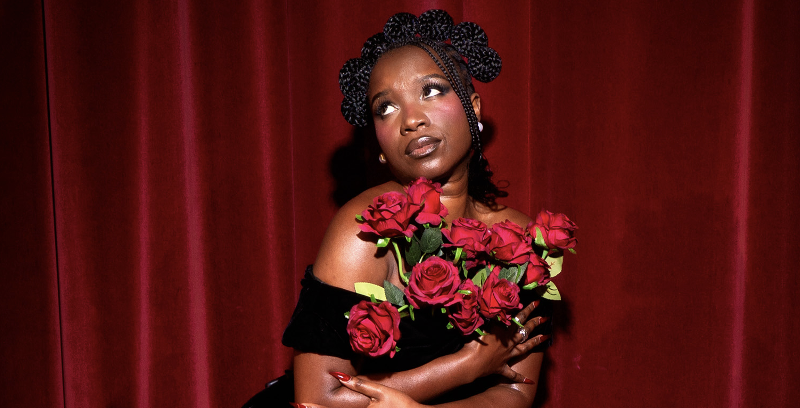
Image credit: Jade Ang Jackman
She chooses not to divorce romantic love from the erotic nature of sexual pleasure, instead seeing pleasure as “the very lubricant of love”, and showcases a journey between the heart and “Infinity Pussy” to repair the tension that exists between them. In LOVER GIRL, “Infinity pussy” had felt neglected by the heart early on in Temi’s life. When she learns to embrace sensuality, in pursuit of unadulterated pleasure, the heart is abandoned but the show culminates with a step towards reconciliation. A recognition that both are needed to experience love to its fullest potential, and perhaps most importantly, that life is about feeling.
The feeling I got walking out of the Soho Theatre after watching the preview of Temi Wilkey: LOVER GIRL at Soho Theatre, reminds me of how I feel listening to So Easy to Fall in Love by Olivia Dean. In a time where the whimsical and care-free nature of romantic love that used to define pop music and romantic comedies has been replaced by a murky cynicism, her music feels like a reprieve. The spirit of that music resonates in the same way that Temi’s work does, and it is an intentional effort from her.
At the start of our call, I ask Temi what is one thing she wishes people complimented her more on, and she confesses “all I really care about is that people find me funny and people think I can sing”. For anyone who has seen, or will see LOVER GIRL, if nothing else you will leave the show certain of these two things. Curating a playlist spanning across R&B, gospel, dancehall, afrobeats and soca, as well as delivering a memorable stand-up show, Temi is a formidable performer. The brazenness of the show’s themes and gags is a fascinating thing to observe with a British audience who are often defined by shyness, or for Temi, repression which she says “runs contrary to Africaness”, which she brings to the forefront of the show through colour, expression and lack of self-restraint.
When I ask Temi how everything comes together, and what she would like for audiences to take from the show, she pauses. She tells me that in making her one woman show, there is the feeling of being “wrought” in the process, and not consciously thinking about overarching themes in the same way an audience member would, and that if I tell her what I think it is, she can add to it.
There’s a lot in the show, and it cuts across elements of romantic love that feel so specific to black women, such a desirability in predominantly white spaces, hair and religion. It touches on queerness, and what that looks like specifically for bisexual women who tend to have their sexualities defined for them outside of themselves. For me, it’s an abandonment of shame and the embracing of mind, body and soul with an emphasis on the body, exposing it to play, pleasure and the freedom to move at will.
Temi’s resounding aim for the show, and for the trilogy is “for people to be truly free”.
“The trilogy is all about love and indulgence and self-indulgence and freedom ultimately”. As it pertains to romantic love and relationships, Temi profoundly notes that “it’s not always going to be paradise, it might not always be rosy, but if you sharpen each other, like flint, if you’re transformed through the challenges of negotiating the real truth of who you are, with the real truth of who someone else is, I think that is a building block towards everybody within a community getting what they need.”
After watching the show, and speaking with Temi, it does feel clear that she is the ultimate LOVER GIRL. Love becomes more than the pursuit of pleasure or companionship, or feelings that may or may not last a lifetime, it is all of those things and more. Temi pours all of this into the show, and it is just what Edinburgh Fringe needs.
Temi Wilkey is at the Edinburgh Festival Fringe at Pleasance Courtyard (Upstairs) until 30 August, and at Soho Theatre 2 - 21 November