Our Father by Mo Korede – ★★★☆☆
Grief is an experience that takes over all of our senses, our minds and our hearts. It can be an impossible obstacle course to make your way through, clumsily and often without much grace. In Mo Korede Our Father, grief is a cyclical journey, that doesn’t start and end with loss. A multi-generational story of love persevering through and after life, Our Father is a delicate unravelling of grief in the lives of one family, and the story of how they try to overcome it.
A two-hander, left in the care of Lara Grace Ilori and Joseph Black, the play begins with the two of them silently moving across the space. A green sofa chair sits in the middle of the stage, around it furniture and suitcases litter the floors. There are white sheets draped across the back wall and it feels like we are in the ghost of what was once a home. Without uttering a word, you can tell that these two people are in pain. We stay in this stillness, for what feels like an eternity, with gentle voiceless melodies playing in the background, Black walks up the steps in the partition of the audience, a departure, leaving Ilori on the stage, feeling her way through objects.
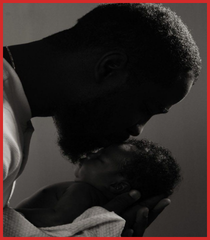
When the dialogue starts, a poetic intrusion of the stillness, it starts with both characters announcing the loss of the fathers. Asenath’s (Ilori) father passed away when she was 9, and Alpheus’ (Black) father found the Christian faith when Alpheus was 29. Both characters lose their fathers to forces above them that they can’t control. Before Alpheus’ father found faith he was absent, a good and loving man, but not always the best father, and so his experience is somewhat similar to Asenath’s, who felt the emptiness left in the wake of her father’s death, a man who adored and doted on her.
Korede’s script and direction is thoughtful and tender, with keen attention to detail and meaning woven into every nook and cranny of the story. The sheets, at first glance, seem ornamental but eventually become physical anchors for the characters; they become the cape worn by Alpheus, demonstrating how he felt his father was a superhero, and the same sheet will transform into the veil Asenath dons on her wedding day. The play is divided into chapters, named after biblical figures and their accompanying stories, and the characters play vinyl records that bear the same name as we walk through each chapter.
At some point, it becomes clear that Asenath is, in fact, Alpheus' daughter, and there are moments where timelines merge, and the barrier between past and present is broken so that we can see the kind of relationship they had, through flashbacks and retellings of moments that live on in their memories. Both actors handle their characters with care, and use their bodies to display the physical impact of grief, and how the body holds memories. They learn to grieve and love and at the same time, learning to forgive while making space for anger.
Our Father is a very heavy play from the start, and there are very few lighter moments to balance this. There is constant intensity that means it loses some of its impact, as every scene requires the same level of emotional consideration. Though well written, with beautiful poetry and movement, it felt like it needed something to break up the gravity of the story.
Korede writes and directs a piece that has both softness and depth, and offers a multi-dimensional lens to the meaning of fatherhood. Incorporating faith, the endless spinning of time and genuine heart, Our Father is an emotional and beautifully poetic show.
★★★☆☆
By Melody Adebisi
Our Father is showed at Canada Water Theatre as part of Peckham Fringe 2026