A Place to Dance by Poliana Lima and Yinka Esi Graves - ★★☆☆☆
On a cold autumnal evening at The Place London Contemporary Dance School, it wasn’t clear how many attendees of A Place to Dance knew that they would walk into a dark room effectively made into a club. House music boomed through the floor, a DJ hunched over a laptop in the corner, and smoke swirled in columns under lights in the ceiling.
Immediately, the audience separated into two groups: the more confident gathered in the centre over a small table serving bottles of manzanilla wine, palm drink and cachaça. A couple of brave people sashayed to the bassline, but most opted for the alcohol and within minutes, a bottle had overturned on the floor. Those who were more timid huddled around the walls, surveying the scene in bemused silence.
A Place to Dance is one of the many performances of Dance Umbrella, an international dance festival taking place across London until the end of October. The piece, created by Brazilian dancer Poliana Lima and British choreographer and dancer Yinka Esi Graves, is advertised as a moment where dance ‘is an invitation to belong,’ in keeping with the festival’s celebration of London’s kaleidoscopic cultural heritage.
The audience was indeed diverse: young people with oversized hair clips and mesh tops mingled with silver-haired women in hiking boots. When Lima and Graves first shuffled onto the dance floor, they blended in, mirroring the tentative two-steps of audience members. Then, smiles rippled across the room as the dancers added flair and energy to each person’s moves until the mood shifted to one more akin to a real club. Winter jumpers were peeled off, brochures were commandeered as fans, and shot glasses proliferated. A brief spell of twerking broke out.
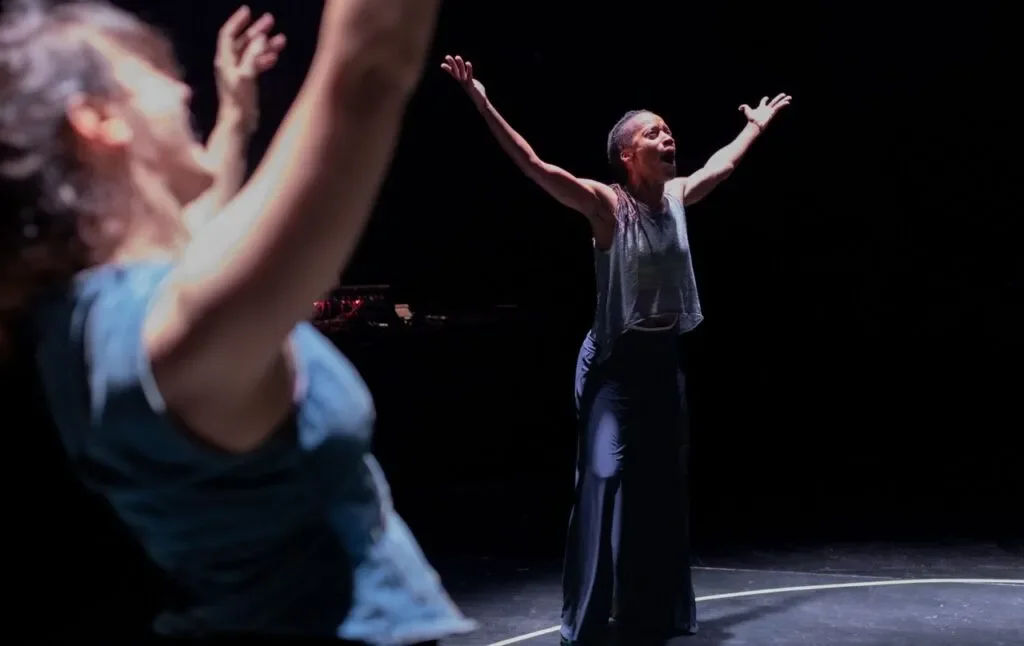
Then, everything but the bassline faded, audience members were directed to set up their chairs around the walls of the room, and Lima and Graves faced each other across a neon circle taped out on the floor, locked in an intense eye contact. This section of the performance began in silence with incremental movements of the shoulders, only accompanied by the occasional gasp or exhale. The sense was of a conversation through movement, growing in intensity and volume as gasps became shrieks, wails and cawing, which were played back until the room seemed to fill with the sound of a rainforest as Graves and Lima hurled their limbs towards one another and the audience.
The effect in this central piece of the performance, as well as another flamenco-inspired segment accompanied by percussionist Lucía Martinez, was one of release, from the conventions of dance traditions or the self-consciousness inherent to performance. But with limited music and no clear narrative, it was difficult to access the emotion of the piece, and Lima and Graves’ different dance styles didn’t always come together into a cohesive whole.
Still, once the dancers left the floor at the end of the performance and music surged through the room again, it was a joy to watch audience members jump to their feet with the encouragement of ushers and start dancing with abandon. The woman in hiking boots was wriggling her hips, a man across from her was shaking his entire body, and as Lima and Graves re-entered the fray and hugged one another, it was impossible to resist the urge to get up and jump to the beat.
By Olivia Konotey-Ahulu
★★☆☆☆